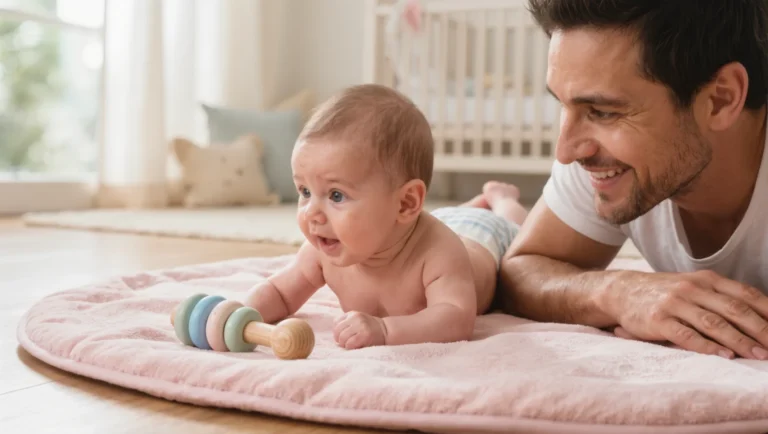


Most babies start reaching for and holding toys on purpose around 4 months – at first with the whole palm. Around 6 months they “rake” things in with all their fingers, around 9 months the pincer grasp (thumb + index finger) appears, and by the first birthday it becomes precise.
You’re sitting on the floor, holding a rattle in front of your baby, and waiting. They stare at it, wave their arms, bop it with a tiny fist… and still don’t grab it. Meanwhile, according to Grandma, the cousin of the same age “was already holding a biscuit”. 😅
If you’re wondering whether everything is fine – relax, that’s completely understandable. Grasping isn’t a switch that flips on a set day; it’s a skill built step by step over the whole first year. Every baby has their own pace. You’ll find more milestones in our Development & Play section.
When do babies start grabbing toys?
Around 4 months, most babies begin deliberately holding objects with the whole palm and bringing them to their mouth. According to the AAP (American Academy of Pediatrics), over the next months they start using a mitten- or rake-like grip, and between 6 and 8 months they pass a toy from one hand to the other.
In the first weeks, your baby squeezes your finger by reflex – an automatic reaction, not yet a deliberate grasp. The real “mission” begins when eyes and hands start working as a team: your baby sees something interesting, reaches out and grabs it. Usually straight into the mouth – that’s where the “lab analysis” happens. 🔬
What is the pincer grasp and when does it appear?
The pincer grasp is the ability to pick up a small object between the thumb and index finger – like tweezers. According to the AAP, it appears around 9 months. At first babies use the pads of their fingers, and by around one year, according to Cleveland Clinic (a US academic medical centre), they pick things up with their fingertips.
It sounds small, but it’s a big step. This very grip will later help your child feed themselves, do up buttons and, one day, hold a pencil.
What does grasping look like month by month?
The ages below are guideposts, not an exam. It’s normal for a baby to be a few weeks ahead or behind.
| Around age | What you might see |
|---|---|
| First weeks | Reflex squeezing of anything that touches the palm |
| 4 months | Holds an object with the whole palm and brings it to the mouth |
| 6 months | “Rakes” small things into the palm with all fingers, without the thumb |
| 6–8 months | Passes a toy from hand to hand, turns and twists it |
| 8 months | Holds things between the thumb and the side of the curled index finger |
| 9 months | First pincer grasp using the finger pads |
| Around 12 months | Precise pincer grasp with the tips of thumb and index finger |
According to Berkshire Healthcare (part of the NHS, the UK’s health service), by 9–10 months many babies pick up a small toy with one hand, bash two blocks together and put a toy down on purpose without dropping it. They stress that it’s entirely normal for children to develop at different rates.
Read alsoSensory toys: how to choose safelyMontessori toys by age: how to choose
Place the toy slightly to the side rather than right in front of your baby’s face. That way they have to stretch out, judge the distance and “take aim” – a proper hand-eye workout. And when they get it, celebrate like it’s the winning goal in a cup final. 👏
How can you help your baby practise using their hands?
The best workout is ordinary play on the floor. You don’t need expensive toys: your baby needs time, interesting objects of different shapes and textures, and you nearby. Here are a few simple steps, roughly in order of age.
- Tummy time: a toy in front of your baby motivates them to lift their head and reach. More ideas: Tummy time: why it matters and how to make it fun.
- A play mat with hanging toys: rings, a little mirror and soft rattles that are easy to grab.
- Objects with different textures: a soft ball, a wooden ring, a crinkly book. How to choose: Sensory toys: how to choose safely.
- Things to “move around”: a plastic bowl with large wooden blocks – for tipping out and taking out.
- Kitchen “instruments”: a wooden spoon, plastic cups, a saucepan – a full orchestra. 🥄
- Finger foods (around 9 months): soft pieces of ripe banana or avocado, supervised. How to cut food safely: Safe Weaning: How to Cut Food and What to Avoid.
Once your baby sits more steadily, their hands are freed up for play. If that’s where you are right now, see also: When do babies sit up on their own? Milestones and gentle help.
How do you play safely with small objects?
Once your baby can pick a crumb off the floor, they can pick up a button too. The AAP advises removing anything from their reach that they could choke on or hurt themselves with. Play with small objects only while you’re watching, and keep buttons, coins, batteries and small parts up high.
Lie on the floor and look at the room from your baby’s height. Suddenly you’ll spot the forgotten button under the sofa and the earring by the bed. A two-minute “patrol” every evening – and you can relax. 🌿
For dads
Grasping games are excellent dad territory. Sit on the floor, hand over toys, hide them under a muslin and “find” them again. Bang blocks together and laugh at the noise. And the evening floor check for small objects can be entirely your mission.
When should you ask your paediatrician?
Different paces are normal, but it’s a good idea to mention it to your paediatrician if around 6 months your baby still isn’t reaching for or holding toys, if their hands are almost always clenched into fists, or if it seems they’ve stopped doing something they could already do. And also if you simply have a feeling that something isn’t right – your paediatrician knows your baby and will take a look.
In short
Grasping is learned over a whole year: from reflex and little fists, through the “rake”, to a precise pincer around the first birthday. You don’t need to train your baby like an athlete – the floor, a few interesting objects and your smile are enough. Those little hands get more skilful every day, and you’re their best coach. 💛
Sources: AAP / HealthyChildren.org – Movement Milestones: Babies 4 to 7 Months; Cleveland Clinic – Finger to Thumb: What To Know About the Pincer Grasp; Berkshire Healthcare NHS Foundation Trust – Typical development; Just One Norfolk (NHS) – Development 6–12 months.