

Sunday afternoon at Grandma’s. Your baby’s cousin, the same age, is sitting like a tiny Buddha, happily banging a spoon. Yours is leaning like a Jenga tower three moves too late. And, of course, someone asks: “Not sitting yet?” 😅
If that stung a little, that’s completely understandable. Sitting is one of those milestones everyone loves to compare. The good news: the window in which babies learn to sit is wide, and your baby is following their own timetable.
Relax, everything’s fine. Let’s look at what the evidence says and how to turn practice into play.
When do babies sit up on their own?
According to the AAP (American Academy of Pediatrics), babies work hard on sitting between 4 and 7 months, and between 6 and 8 months most will stay sitting without leaning on their hands once you place them upright.
The largest study on this comes from the WHO (World Health Organization): researchers followed 816 children in Ghana, India, Norway, Oman and the USA. In this group, sitting without support appeared between 3.8 and 9.2 months – the normal range among healthy children. Interestingly, this is the narrowest window of the six big motor milestones, yet there’s still almost half a year between the earliest and the latest sitters.
The CDC (US Centers for Disease Control and Prevention) lists “sits without support” on its 9-month checklist. One important detail: these checklists show what 75% or more of children can do by that age, not the average age. So many babies sit earlier, and the later ones aren’t necessarily behind.
What do the stages look like?
- Strong neck and back: it all starts with tummy time, when your baby lifts their head and pushes up on their arms. That builds the upper-body strength that later keeps the back upright.
- The “tripod”: your baby sits leaning forward, propped on their hands in front – like a tiny sprinter on the starting blocks.
- Hands-free sitting: the back straightens and the hands are free for play. Sideways topples still happen, and that’s part of learning.
- Steady sitting: according to the AAP, from around 8 months babies usually catch themselves with their arms when they tip and reach for toys without falling.
- Getting into sitting alone: later, your baby figures out how to push up from their tummy into sitting. That’s a separate skill and often comes after sitting itself.
How can you help your baby sit up?
No special equipment needed. Just floor time, a little patience and your company.
- Plenty of tummy time: it’s the foundation. For ideas, see Tummy time: why it matters and how to make it fun.
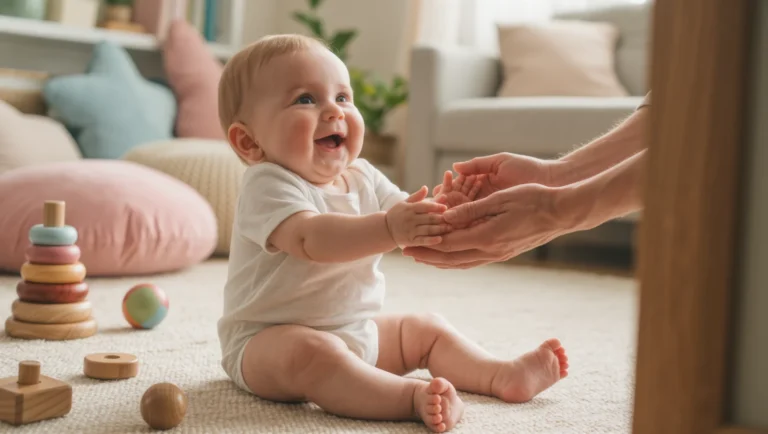
- Supported sitting: the AAP suggests holding your baby or supporting their back with pillows while they learn to balance – only while you’re right there and they’re awake.
- Something interesting in front: a toy right in front gives your baby a reason to straighten up and balance.
- Sitting in your lap: sit on the floor with your baby between your legs. You’re the comfiest, safest backrest there is.
Read alsoWhen do babies respond to their name? Calm, clear milestonesWhen do babies hold their head up? Milestones without stress
Sit your baby on the floor between your legs and blow soap bubbles for them to catch. Reaching up and to the side trains their balance – and they’ll have no idea they’re “working out”. 🫧
Staying safe while they learn
- Never alone, not even for a second: a baby learning to sit can topple suddenly, often sideways or backwards.
- Low and soft: practise on the floor, on a rug or play mat – not on a bed, sofa or table. The AAP even suggests moving nappy changes from the changing table to the floor or bed at this stage, because babies roll in a flash.
- Pillows are for play, not sleep: remove them when your baby dozes off. Sleep is always on the back in an empty cot (more in Baby Sleep).
- A clear floor: once your baby sits, their hands reach further. Check for small objects, coins and button batteries nearby.
Put their favourite toy slightly to one side rather than straight ahead. Your baby will learn to twist and reach without losing balance. And when they grab it – big applause. 👏
What if my baby skips a step or does things “out of order”?
Some babies crawl first and sit later; others sit for ages before they move. In the WHO study, about 90% of children went through the milestones in the usual sequence, and 4.3% never crawled on hands and knees at all. More on that in Crawling: when it happens and why some babies skip it.
If your baby was born prematurely, the doctor usually looks at development by corrected age – that is, from the date they were due. Ask how this applies to you.
For dads
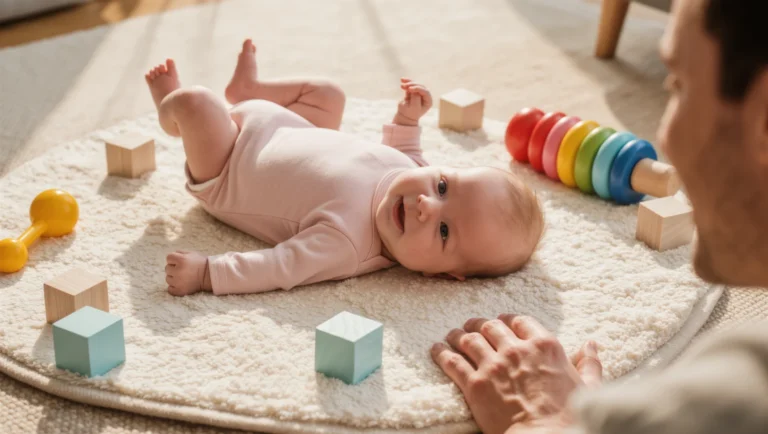
Sitting practice is the perfect dad game. Lie on the floor, sit your baby facing you and play peekaboo behind a muslin, roll a ball or build a tower for them to knock down. You’re coach, cheering crowd and soft crash barrier all at once.
When to ask your paediatrician
The AAP advises letting your paediatrician know if your baby isn’t sitting by themselves by 9 months. Also mention it if:
- their head still flops back when you gently pull them up to sitting (around 7 months);
- their body seems very stiff, or very floppy, “like a rag doll”;
- they consistently use only one hand or one side of the body;
- they lose skills they already had;
- you simply feel something isn’t right. Your instinct counts.
These aren’t diagnoses, just reasons for a conversation. Your doctor knows your baby and will judge whether anything more is needed. For more month-by-month guidance, see Baby development month by month: 0–12 months at a glance and Development & Play.
In short
Learning to sit is like learning to ride a bike: a bit of wobbling, a few soft tumbles and then, suddenly, balance. Most babies get there between 4 and 9 months, each in their own way. And you, sitting beside them on the floor, are already doing the most important part. 💛
Sources: AAP / HealthyChildren.org – Movement Milestones: Babies 4 to 7 Months; AAP / HealthyChildren.org – Movement Milestones in Babies 8 to 12 Months Old; AAP / HealthyChildren.org – Developmental Milestones: 7 Months; WHO Multicentre Growth Reference Study Group – WHO Motor Development Study: windows of achievement for six gross motor development milestones, Acta Paediatrica 2006; CDC – 9 Month Milestone Checklist (Learn the Signs. Act Early.).