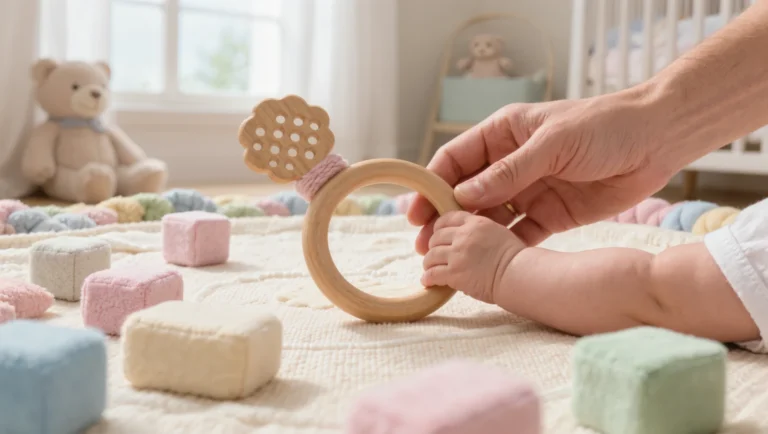


Most babies lift their head briefly while lying on their tummy at around 2 months. By about 4 months, they usually hold it steady without support when you’re holding them. These are guideposts from the AAP (American Academy of Pediatrics), not a deadline.
You carry your newborn like a crystal vase and spend all day reminding visitors: “the head, mind the head!” 😅 Then someone mentions that their neighbour’s baby “held it up like a little soldier at one month” – and suddenly you’re counting days.
Relax, it’s all fine. Neck muscles build up gradually and every baby has their own pace. You can help with a little play every day – no gadgets, no pressure.
When do babies start holding their head up?
According to the AAP, most babies lift their head while lying on their tummy at around 2 months, and hold it steady without support when held at around 4 months. Control comes in stages: short lifts first, then longer and more confident ones. A little earlier or later is usually within the normal range.
In the first weeks a newborn can turn their head to the side (for example, towards the breast at feeding time), but has very little neck control. That’s why you support the head and neck with your hand whenever you lift or carry your baby.
| Age (guide) | What you may see |
|---|---|
| First weeks | Turns head to the side, but needs your support |
| Around 2 months | Lifts head while lying on tummy |
| Around 4 months | Holds head steady when held; pushes up on elbows on tummy |
How can I help my baby hold their head up?
The best “workout” is tummy time – while your baby is awake and you’re right there. According to the AAP, it strengthens the muscles needed for the next skills. You can start in the first days at home with short sessions, building up as your baby starts to enjoy it.
- Start on your chest. Lean back and lay your baby tummy-down on you – they’ll lift their head to see your face. Only when you’re fully awake.
- Short and often. The AAP suggests a few minutes, 2–3 times a day, then gradually more.
- Get down on the floor. Your face or a toy right in front is the best motivation.
- Try a rolled towel. If it’s hard for them, Berkshire Healthcare NHS Foundation Trust suggests a rolled-up towel under the armpits.
- Mix up positions. On the back, on the tummy, in your arms – variety helps.
More ideas in our guide Tummy time: why it matters and how to make it fun.
Read alsoWhen do babies sit up on their own? Milestones and gentle helpWhen do babies respond to their name? Calm, clear milestones
The sweet spot for tummy time is after a nappy change or a nap – your baby is awake, dry and in a good mood. Not straight after a feed, unless you fancy testing your laundry skills. 😉
How much tummy time does a baby need a day?
The AAP suggests starting with 2–3 short sessions a day of 3–5 minutes and gradually working up to 15–30 minutes a day in total by around 7 weeks. Berkshire Healthcare NHS gives a similar guide: around 20–30 minutes a day by 3–4 months, until your baby can roll over on their own.
The minutes add up across the day – they don’t have to be in one go. If your baby protests, stop, cuddle and try again later. Most babies get used to it after a few tries.
Is it normal for a baby to hate tummy time?
Yes, many babies protest at first when placed on their tummy. According to the AAP, they usually do better after a few tries, especially with something interesting in front of them – your face or a toy. Start with a minute or two and stop before they get upset.
Put a shatterproof baby mirror in front of them. Babies love faces – even their own. A new “friend” on the floor works wonders. 🪞
Do bouncers and seats help?
Not really. The AAP notes that long stretches in bouncer seats give babies less chance to practise using their muscles. It also suggests limiting time in swings, bouncy chairs and car seats outside of travel, so there’s less constant pressure on the back of the head.
They’re handy for short spells, but free time on the floor is worth more. More in Development & Play.
For dads
Lie back on the sofa and put your baby tummy-down on your chest: they lift their head to see you, you pull funny faces. It’s a workout for both of you – neck muscles for them, sense of humour for you. Just stay awake.
When to talk to your paediatrician
The AAP advises talking to your paediatrician if your baby stops doing something they could already do, uses only one side of the body, seems especially floppy, or if their whole body shakes. Berkshire Healthcare NHS adds: if your baby can’t lift their head and prop up on their forearms on their tummy and it doesn’t improve with practice, speak to your health visitor or doctor.
If something worries you, just ask at the next check-up – your paediatrician knows your baby and will reassure you or point the way.
In short
Head control comes step by step: short lifts on the tummy around 2 months, then steady control around 4 months. A little floor play every day is all you need. You’re already doing the most important thing – being right there. 💛
Sources: AAP / HealthyChildren.org – Developmental Milestones: 1-4 Months Old; AAP / HealthyChildren.org – Movement Milestones: Birth to 3 Months; AAP / HealthyChildren.org – Back to Sleep, Tummy to Play; Berkshire Healthcare NHS Foundation Trust – Tummy time.