
The first goes at tummy time often look like this: your baby plants their nose in the blanket, grumbles, and gives you a look that says “seriously?”. If that’s happening at your place, it’s completely normal. Lots of babies protest at first – and then fall in love with this new view of the world.
Every baby gets used to it at their own pace. Your job isn’t to set a record; it’s to have little tries together.
The short answer: Start in the first days, a minute or two a few times a day, only while your baby is awake and you’re right there. The WHO recommends at least 30 minutes a day in total, spread through the day, for babies who aren’t moving around yet.
What is “tummy time”?
Simply time your baby spends lying on their front while they’re awake and you’re right there. The American Academy of Pediatrics (AAP) sums it up with an easy-to-remember rule: “Back to sleep, tummy to play”.
Why does it matter?
When your baby lifts their head on their tummy, they’re doing a whole little “workout programme”:
- It strengthens the muscles of the neck, back and shoulders – the foundation for rolling, sitting and crawling.
- It helps with head control and hand–eye coordination.
- It gives the back of the head a break. That lowers the risk of the head flattening at the back or side (this is called positional plagiocephaly – in plain words, a “flat spot”).
- It shows them the world from a completely different angle.
When and how much?
You can start in the very first days – the easiest way is with your baby on your chest while you’re fully awake. The rule is “little and often”: at first a minute or two a few times a day, then gradually more.
The World Health Organization (WHO) recommends at least 30 minutes a day in total for babies who aren’t yet moving around on their own, spread through the day. Not all at once – in small portions while they’re awake. By around three months, most babies can prop themselves up on their forearms and hold their head up.
Pick a moment when your baby is awake and in a good mood – for example after a nappy change. Many parents prefer not to do it straight after a feed, when the tummy is full. And don’t worry about the stopwatch – two happy minutes are worth more than ten tearful ones.
How to make it enjoyable
The secret ingredient isn’t an expensive play mat – it’s your face. Babies love looking at people up close. Ideas to try:
- Lie on the floor face to face with your baby and pull silly faces.
- Recline and lay them on your chest – that counts too.
- Tuck a softly rolled towel under their chest and armpits to make it easier.
- Put a shatterproof baby mirror or a high-contrast picture in front of them.
- Sing, chat, scratch softly on the rug – anything that holds their attention.
- Stop before the grumbling turns into proper crying. Try again later.
Safety first
- Only when your baby is awake and you’re right there. Never leave them alone on their tummy.
- Use a firm, flat surface – the floor with a mat or a blanket.
- If they doze off, move them to their cot and lay them on their back.
What if your baby won’t have any of it?
That’s not a sign that something’s wrong or that you’re doing it wrong. For a tiny body, lifting the head is a real workout – and who loves their first day at the gym? 😄 Shorter but more frequent tries usually do the trick. So does variety: the floor today, your chest tomorrow, across your lap another time.
If there’s an older brother or sister, invite them to lie down in front of the baby and pull funny faces. For lots of babies, other kids are the most interesting show on earth. Under your watchful eye, of course.
For the dads
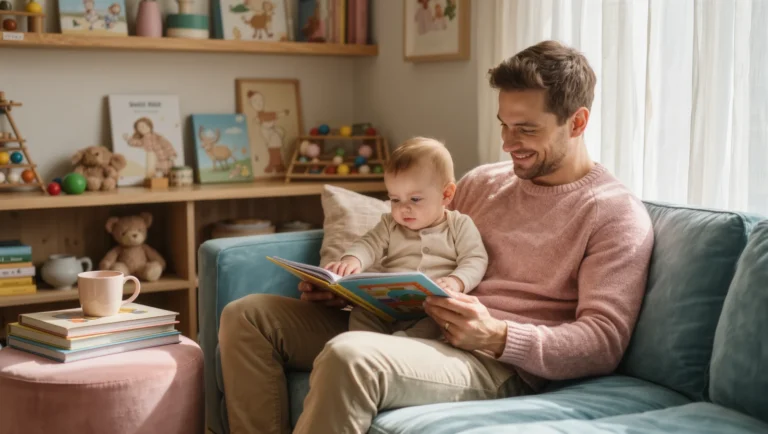
Dad’s chest is one of the best “mats” for tummy time: warm, steady and with a face nearby. Recline on the sofa, lay your baby tummy-down on you and tell them about your day. Nobody said a workout can’t also be a chat.
When to mention it to your paediatrician
Bring it up at the next check-up if you notice that your baby’s head looks flattened on one side, that they almost always keep their head turned to the same side, or that by around 4 months they still find it very hard to hold their head steady. These are things a paediatrician checks easily, and there are often simple fixes.
In short
Tummy time isn’t homework to tick off. It’s one more way to be together – face to face, minute by minute. Two minutes today, five next week. Every little try counts – and you’re doing better than you think. 💛
Sources: American Academy of Pediatrics (HealthyChildren.org) – Back to Sleep, Tummy to Play; WHO – To grow up healthy, children need to sit less and play more; NHS Berkshire Healthcare – Tummy time; NHS Oxford Health – Tummy time (leaflet).
More from this section


Your baby, week by week
Once a week: what's coming up, one useful tip and nothing extra.