This guide may contain affiliate links. If you buy through them, we may earn a small commission at no extra cost to you. Learn more
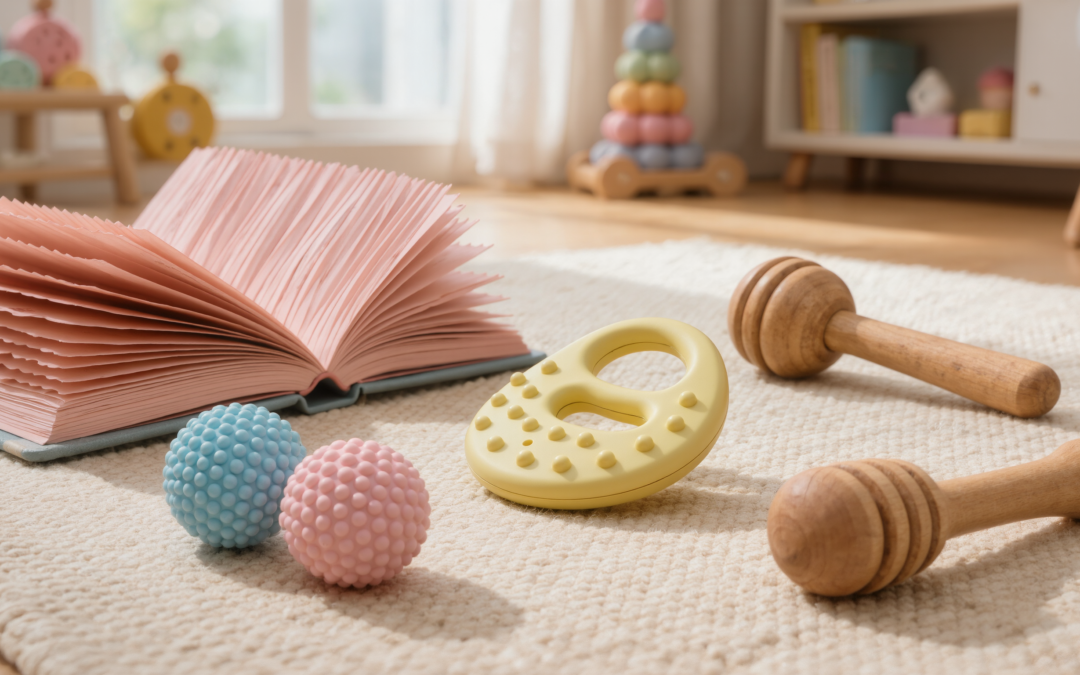
Crinkly books, spiky balls, glowing bottles full of glitter… The world of sensory toys is colourful, noisy and pretty good fun. And as with anything that ends up in little hands (and from there, in little mouths), there are a few things worth knowing.
Every baby explores the world in their own way – some with their eyes, some with their hands, some with their gums. And every one of those ways is right.
The short answer: Choose for the stage: soft, light things for a young baby, one-piece washable toys for teething, things to take out and put in for a toddler. Check for a CE mark, an age label, no small parts and a secure battery compartment. Water beads have no place near babies.
What is a sensory toy?
It’s any toy that “talks” to the senses – touch, sight, hearing. Different textures, contrasting colours, rattling, rustling. The good news is that it doesn’t have to be bought with a “sensory” label. A wooden spoon, a silicone cupcake case or a piece of soft fabric is already a whole adventure.
What to consider before you buy
Instead of hunting for the one “best” toy, ask yourself: what matters most to you, at this stage?
- For a young baby – light, soft things to grasp, with different textures and gentle sounds.
- For the teething phase – one-piece toys that are easy to wash.
- For a toddler – things to take out and put in, a tambourine, a textured puzzle.
Toys with lights and music are fun and eye-catching, but they often do most of the “work” instead of your child. Simple objects invite your baby to discover things for themselves. Both kinds have their place – what matters is that they don’t crowd out playing with you. The American Academy of Pediatrics reminds us that electronic toys on their own don’t provide the interaction a parent does.
Before handing over a new toy, give every part a gentle tug – eyes, ribbons, labels, beads. If anything shows signs of coming loose in your hand, it’ll come loose in a baby’s mouth too. This check is worth repeating every now and then – toys wear out.
Safety: a quick checklist
- CE marking and an age label. In the EU, toys for children under 3 must not contain small parts that can be swallowed or inhaled. A symbol with a crossed-out baby and “0–3” means the toy is for older children.
- Secured batteries. Button batteries (the small, round “coin” ones) are very dangerous if swallowed. In the EU, toys must have a secure battery compartment – usually with a little screw. Check the screw is in place, and keep spare batteries well out of your child’s reach.
- No water beads. The small, colourful balls that swell up in water are often sold for “sensory play”. The US Consumer Product Safety Commission (CPSC) warns that if swallowed, they keep growing inside the body and can cause an intestinal blockage. They’re not for babies and young children, and shouldn’t be in the home – even if they belong to an older sibling – without secure storage.
- Strong seams and glued lids. With soft toys – no split seams with stuffing showing. With homemade “sensory bottles” – the lid should be glued shut and the bottle sturdy.
- A trustworthy seller. When buying online from unknown sellers outside the EU, the risk of products not meeting requirements is higher.
If something has been swallowed
If you suspect your child has swallowed a button battery, a magnet or a water bead, don’t wait for symptoms. Call 112 or get emergency help straight away – even if you’re not sure. The French safety agency ANSES advises exactly this: if in doubt, act immediately.
Put all the older children’s small bits in a box with a lid on a high shelf. Bonus: the big brother or sister gets their very own “treasure chest” that the little one can’t reach. 😉
For the dads
If you like making things, a homemade sensory board is your project: a sturdy board, glued-on pieces of fabric, a brush, a light switch, a drawer handle. Just apply the same rules: nothing small, nothing sharp, nothing that can come unstuck. And accept in advance that the light switch will turn out to be the star of the show. 😄
In short
A good sensory toy isn’t the brightest or the loudest – it’s the one that’s safe and invites your child to explore. A few seconds of checking before you buy, a little care at home – and all that’s left is the fun. Your instincts are good – trust them. 💛
Sources: U.S. CPSC – Statement on the Dangers that Water Beads Pose to Young Children; ESPGHAN – Button Battery Ingestion in Children; ANSES – Button batteries: ingestion by young children can have serious consequences; ComplianceGate – Small Parts Regulations and Warnings in the EU.
More from this section



Your baby, week by week
Once a week: what's coming up, one useful tip and nothing extra.