With a newborn, the day often looks like a loop of “feed – nappy – sleep – repeat”. And somewhere along that loop a question pops up: “Am I supposed to play with them? And how, when they mostly just sleep?”
Playing with a newborn is much simpler than it sounds. You don’t need special toys or a schedule. You need your face, your voice and a few awake minutes here and there. Every baby has their own little “windows” of wakefulness – and those are plenty.
The short answer: Keep it simple: your face up close, repeating your baby’s coos, describing what you’re doing, high-contrast pictures, songs and a little tummy time while they’re awake and you’re right there. If your baby looks away, yawns or gets fussy, it’s time for a break.
What can a newborn see and hear?
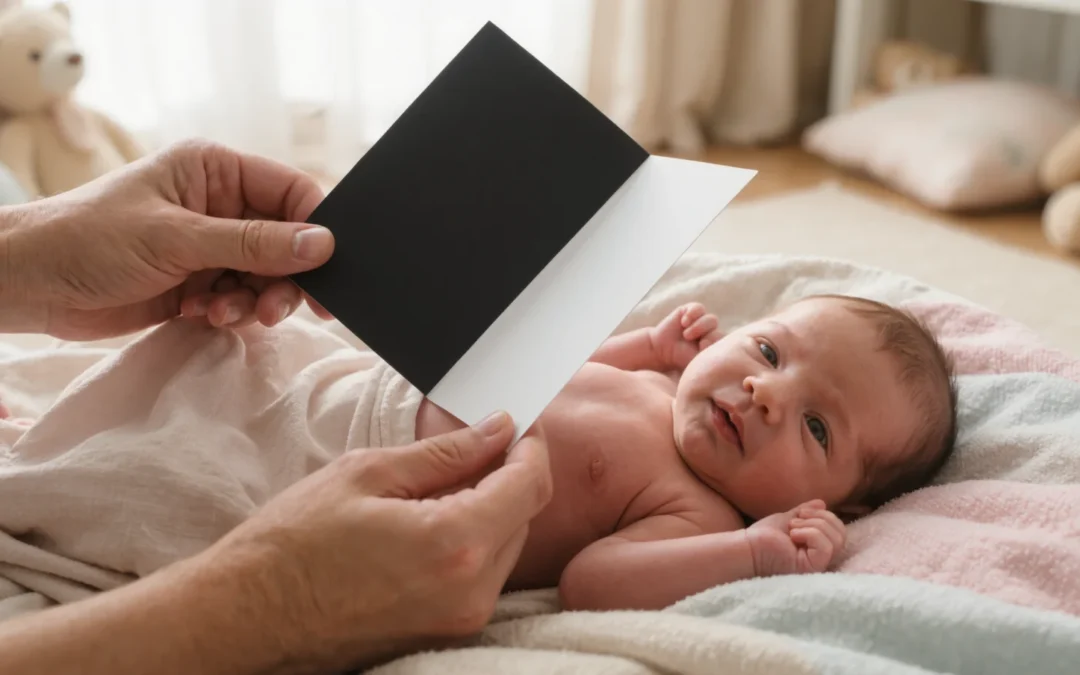
A newborn’s eyesight is still developing, and they can’t see far. That’s why your face up close – like during a feed – is the most fascinating view in the world to them. Babies also gaze longer at high-contrast shapes, like black on white. And your voice they already know from before they were born.
Around two months, most babies start smiling back when you smile at them – and from then on, play becomes more and more of a two-way thing.
7 simple games for the first months
- Face to face. Hold your baby close, smile, open your mouth wide, stick out your tongue. Some babies try to copy you.
- The echo. When your baby coos, repeat their sound and pause. That’s your first conversation.
- Narrator. Describe what you’re doing: “Now we’re washing your hands. The water’s nice and warm.”
- Fingers and toes. Count their fingers and toes, gently stroke their face, make up a little rhyme.
- Follow the movement. Slowly move a high-contrast picture or your face from one side to the other and see if their eyes follow.
- Song and sway. Sing and rock gently in time. The repertoire doesn’t matter – even an advert jingle will do.
- A little tummy time. On your chest or on a mat, while they’re awake and you’re right there. It builds up their neck muscles.
The best time to play is when your baby is fed, dry and has calm, open eyes. If that’s only for five minutes, they’re five minutes well spent. Simply gazing at each other counts as play too. 😊
How do you know they’ve had enough?
Newborns tire quickly – everything is new and intense. If your baby looks away, yawns, gets fussy or startles, that’s their way of saying “that’s enough for now”. Researchers at Harvard advise exactly this: follow your child’s cues for when play starts and stops. A break is part of the fun, not a failure.
For the dads
If you’re wondering how to bond with a baby who still only sleeps and eats – start with skin to skin and a low, calm voice. A deep dad voice and an afternoon nap on your chest are an all-time classic. Safe and loving – in practice, these are your first games together.
No need to buy special cards. Draw a few stripes, circles and a chequerboard with a black marker on white card – and your home “gallery” is ready. Keep it out of your baby’s hands and away from their mouth.
When to mention it to your paediatrician
If by around three months your baby rarely reacts to loud sounds, doesn’t follow your face with their eyes or doesn’t smile back, mention it to your paediatrician. They’ll judge whether any check is needed. Your observations are valuable information – nobody sees your baby as often as you do.
In short
Playing with a newborn isn’t measured in minutes or toys. It’s in the gaze, the song you hum under your breath and the quiet “Oh, you said something!”. You’re already playing with your baby more than you realise – and they can feel it. 💛
Sources: NHS Berkshire Healthcare – Bringing play into your day with your newborn baby; Leeds Community Healthcare NHS – Supporting your baby’s development; NHS Borders – Playing with your baby; Harvard Center on the Developing Child – 5 Steps for Brain-Building Serve and Return.
More from this section

Your baby, week by week
Once a week: what's coming up, one useful tip and nothing extra.