

This guide may contain affiliate links. If you buy through them, we may earn a small commission at no extra cost to you. Learn more
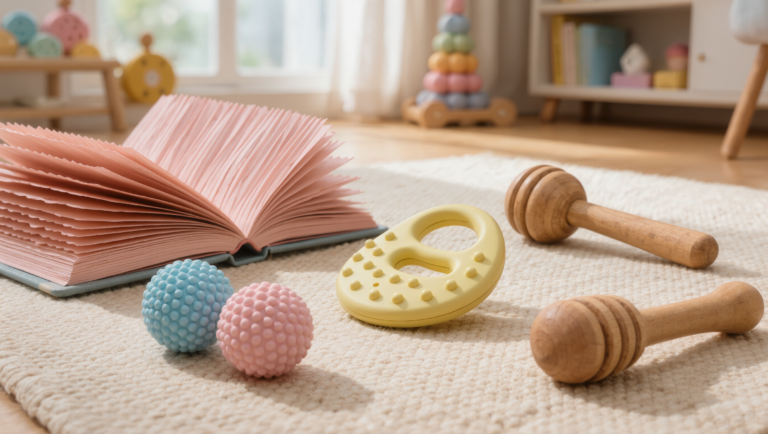
Wooden stacking towers, boxes with holes, balls in pastel colours… Just type “Montessori toys” and your screen fills up with beautiful things. And with the question: “Which of these do I actually need?”
The good news: you don’t need the whole catalogue. There’s no one “right” toy that works miracles. There are a few simple ideas that will help you choose calmly.
The short answer: Look for simple, single-purpose toys that make your child do the work and match what they can already do. Try high-contrast pictures at 0–3 months, grasping rings at 3–6, stacking cups at 6–12 and shape sorters at 1–2 years. “Montessori” on the box isn’t a certificate.
What makes a toy “Montessori”?
The Montessori method is an approach to child development created by the Italian doctor Maria Montessori. Toys inspired by it are usually:
- Simple – no flashing lights or songs at the push of a button.
- Single-purpose – they practise one skill at a time: grasping, posting into a hole, stacking.
- Made from natural materials – often wood, cotton or metal, which have different weights and temperatures under little fingers.
- Active for the child, not for the toy – the baby does the doing; the toy just “responds”.
This is where the idea meets the science. In its clinical report on choosing toys, the American Academy of Pediatrics (AAP) stresses that the best toys are often the simple ones, and that nothing replaces play with a grown-up. The ideal toy matches what your child can already do and gives them a small new challenge.
One more thing: “Montessori” on the box isn’t a certificate. Some of the best “Montessori” toys are already in your kitchen – a wooden spoon, a metal bowl, stacking cups.
Ideas by age
The ages are a rough guide. Follow your child, not the calendar.
- 0–3 months: black-and-white high-contrast pictures, a simple mobile to look at and – most important of all – your face.
- 3–6 months: light rattles and grasping rings, a soft ball with holes, teethers.
- 6–12 months: an “object permanence box” (the ball disappears into a hole and pops out again – that’s how your baby discovers that things still exist even when they can’t see them), stacking cups, a treasure basket of safe household objects to explore.
- 1–2 years: a shape sorter with a few shapes, a stacker with chunky rings, knob puzzles, blocks.
- 2–3 years: more complex puzzles, threading large beads, small “real” tasks – pouring water from a little jug, wiping the table.
Try toy rotation: keep only 4–5 toys out, put the rest away and swap them every few days. In a University of Toledo study, children aged 18–30 months with 4 toys played longer and more creatively with each one than those with 16. Fewer toys – and less tidying up. 😉
Wood or plastic?
Both have their place. Wood is lovely to touch, durable and often gets passed down to younger children, but it’s pricier and not always easy to wash. Good-quality plastic is light, hygienic and affordable. So ask yourself: what matters most to you? Budget, easy cleaning, a toy that lasts for years? The answer is yours – and it’s the right one.
The safety filter (non-negotiable)
Before beauty and philosophy comes one quick check:
- CE marking on the toy or the packaging. It’s the manufacturer’s declaration that the toy meets EU rules. You’ll often also see the EN 71 standard mentioned – a series of European toy safety standards (mechanical strength, flammability, chemicals).
- No small parts under 3 years. Under EU rules, toys for children under 36 months must not have parts that can be swallowed or inhaled. If you see the symbol with a crossed-out baby and “0–3”, or the words “Not suitable for children under 36 months”, that toy is for older kids.
- Bigger than their mouth. The AAP advises that toys for little ones should be bigger than their mouth and have no parts that come off.
- Smooth wood. No splinters, cracks or peeling paint.
- Shop from trusted places. In a 2021 European Commission check, 84% of toys sold online by sellers from outside the EU didn’t meet the requirements.
A quick pre-purchase test – ask yourself three questions. Is it safe for this age? Will my child do the doing, or the toy? Can it be played with in more than one way? Three yeses – and you’re on the right track.
For the dads
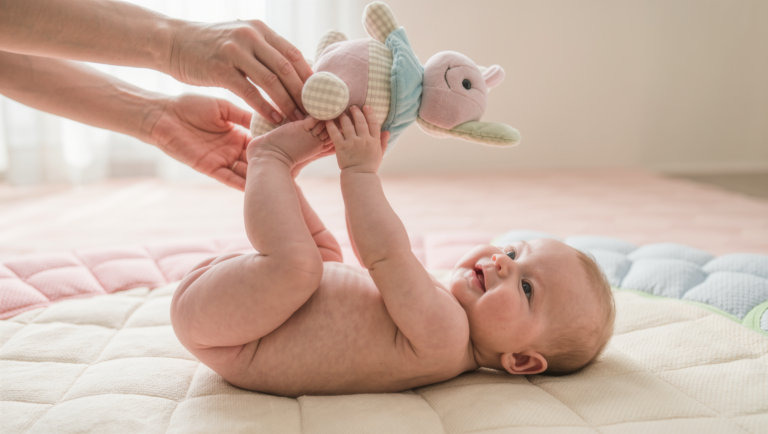
Simple toys are an empty stage – waiting for an actor. A block tower that comes crashing down with a big “BOOM”, or a ball that “vanishes” and comes back, is far more fun for babies when there’s an enthusiastic playmate beside them.
In short
You don’t need a room that looks like it’s straight out of a catalogue. You need a few safe things that suit this stage, and time together. And you’ve already got that. The rest is detail – and you’ll sort it out just fine. 🧩
Sources: American Academy of Pediatrics (HealthyChildren.org) – Best Toys Go Back To The Basics; University of Toledo – Fewer toys lead to richer play experiences (Dauch et al., Infant Behavior and Development); ComplianceGate – Small Parts Regulations and Warnings in the EU (EN 71); European Commission CASP 2021 – Toys from non-EU webshops.
More from this section

Your baby, week by week
Once a week: what's coming up, one useful tip and nothing extra.
