

A child can ride forward-facing once they have outgrown the rear-facing weight or height limits of their car seat. With an i-Size (R129) seat, that’s no earlier than 15 months. The AAP (American Academy of Pediatrics) advises keeping children rear-facing for as long as possible.
Your little one is getting big, giving you that “I want to see the road too” look in the mirror, and your mother-in-law reminds you that “you were facing forward by this age”. 😅 Now you’re wondering if you’re late.
If you’re unsure, that’s completely understandable. The rules really have changed in recent years, and every seat on the shelf seems to say something different. Don’t worry: the answer is simpler than it looks, and by asking you’re already doing the most important thing.
How old does a child need to be to face forward?
With an i-Size seat (labelled R129), a child must ride rear-facing until at least 15 months. That’s a legal minimum, not a recommended switch date. According to the AAP and RoSPA (the UK’s Royal Society for the Prevention of Accidents), it’s safest to stay rear-facing until the child outgrows the seat itself.
The UK government site GOV.UK says height-based seats must be rear-facing until the child is over 15 months old. For older weight-based seats (R44), the minimum is 9 kg. RoSPA explains that many parents switch as soon as they hit these minimums, but there’s no need: some seats allow rear-facing travel up to 18 kg or even 25 kg.
| Guide | What it means |
|---|---|
| i-Size (R129) | Rear-facing until at least 15 months – legal minimum |
| R44 (weight-based) | Minimum 9 kg to switch forward |
| AAP | Rear-facing as long as possible, up to the manufacturer’s limits; most convertible seats allow 2 years or more |
| Extended rear-facing seats | Rear-facing up to 18 kg or 25 kg, depending on the model (RoSPA) |
Why is rear-facing safer?
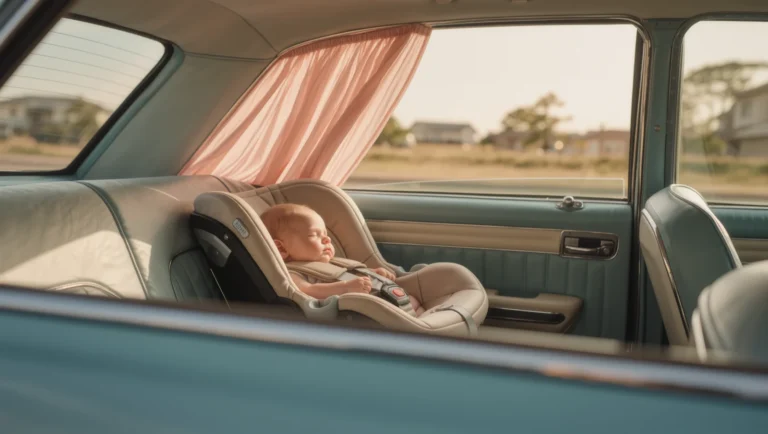
In a sudden stop, a rear-facing seat cradles the child’s whole back, neck and head and spreads out the force of the crash. The AAP explains that young children have large heads for their body size, shallower vertebrae and looser ligaments, so their neck and spine are more vulnerable when facing forward.
RoSPA adds that rear-facing seats protect the head, neck and spine better than forward-facing ones. The AAP also notes that in some countries children routinely ride rear-facing until age 4. That’s why in 2018 the AAP dropped a specific age from its advice and tied it to the seat’s limits instead.
Read alsoWhen can baby face forward in a carrier: calm, clear guidanceWhen can my child move to a booster seat? Calm, clear guide
How do I know my child has outgrown the rear-facing seat?
Your child has outgrown the seat once they reach the maximum rear-facing weight or height set by the manufacturer. RoSPA gives a simple sign: usually the top of the child’s head is above the top of the seat. Your child should also be able to sit up steadily on their own.
- Check the label and manual: they list the maximum rear-facing weight and height.
- Check the head: if the top of it is above the top of the seat back, it’s time for the next step.
- Consider an extended rear-facing seat before turning your child forward.
- Only then move to a forward-facing harnessed seat (and later, see When can my child move to a booster seat? Calm, clear guide).
Take a photo of the seat’s label with the maximum limits. Next time someone asks “still rear-facing?”, just show them the picture. Debate over. 😊
Are bent legs a problem?
Lots of parents worry when their child’s feet touch the vehicle seat. Neither the AAP nor RoSPA lists leg length as a reason to turn a child forward: both point to the maximum weight and height set by the seat’s manufacturer as the guide.
If you’re unsure, read your seat’s manual or ask a child passenger safety specialist.
How do I strap in a rear-facing seat correctly?
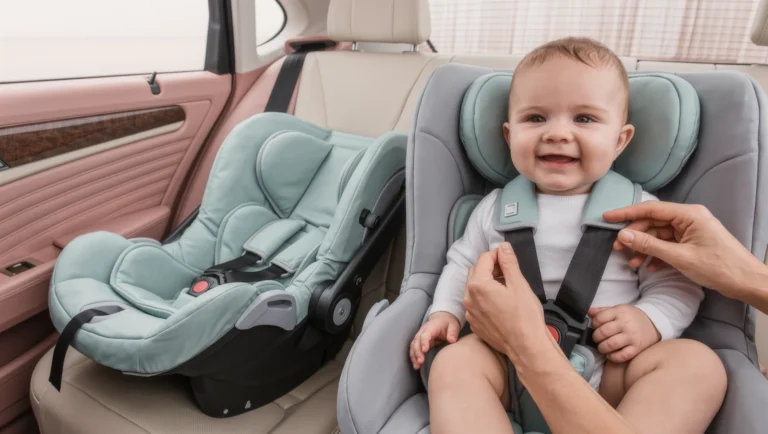
In a rear-facing seat, the top of the harness should be level with or about 2 cm below the child’s shoulders, according to RoSPA. The harness is snug when only one or two fingers fit between it and the child’s chest, and the buckle shouldn’t rest over the tummy.
- Bulky clothes get in the way: check the harness every trip (more in Winter Coat in the Car Seat: Staying Warm and Buckled Safely).
- The back seat is safer. If the seat goes in the front, the passenger airbag must be switched off (Baby car seat in the front seat: when it is OK and airbag rules).
- Isofix or belt: GOV.UK says to use a child seat only with a seat belt that has a diagonal strap, unless the seat is designed for a lap belt or fitted with Isofix (ISOFIX or seat belt: how to fit your baby’s car seat correctly).
Add a small baby mirror to the back seat – your child sees you, you see them, and “it’s boring back here” suddenly becomes “look, Mum’s laughing”. 🎁
For dads
Take charge of fitting and checking the seat. Read the manual carefully once, make sure the seat doesn’t wobble, and adjust the harness as your child grows. Learn the basics of Car seats: i-Size (R129) explained simply too, and you’ll be the family’s resident expert.
In short
Rear-facing is like the seat giving your child a hug at the moment it matters most. You turn them forward once they’ve outgrown the rear-facing limits, not when the calendar or the relatives say so. You’re thinking about their safety, which means you’re already doing brilliantly. 💛
Find more on travelling with your child in Travel & Gear.
Sources: AAP / HealthyChildren.org – Rear-Facing Car Seats for Infants & Toddlers; AAP / HealthyChildren.org – How long should my child ride rear facing?; RoSPA – Rearward-facing Seats; RoSPA – i-Size Seats; GOV.UK – Child car seats: the rules.