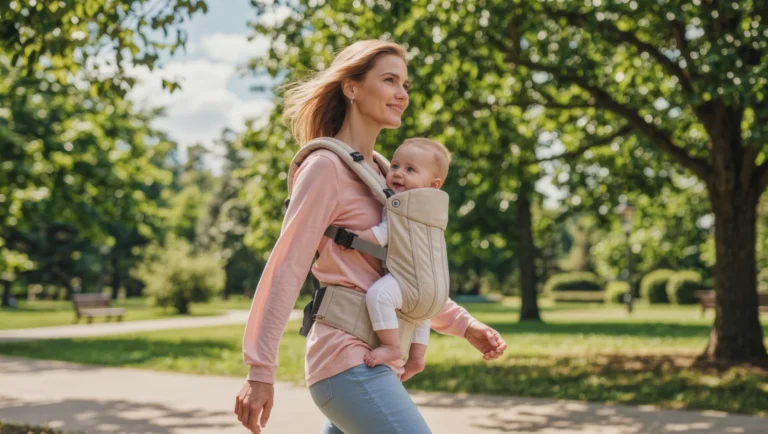


Most babies are ready to face forward in a carrier at around 5–6 months, not earlier. Three things matter: steady head control, sitting with the support of one hand, and a chin that sits above the top edge of the carrier. Until then, facing you is the comfiest and safest view.
It’s Saturday morning, the market is full of colour and noise, and the baby in the carrier is swivelling like a tiny periscope. Trying to see everything – the stalls, the dog, the balloons – and mostly seeing your jacket. 😅 So you wonder: “Is it time to turn them around?”
If you’re unsure, that’s completely understandable. The carrier box says one thing, your friend says another, and the forums say a third. Relax, you’ve got this: there’s no “too late”, only the moment your baby is ready.
When can a baby face forward in a carrier?
The guide is development rather than a date on the calendar. Plunket (New Zealand’s child health organisation) advises waiting until closer to six months, when your baby has good head and neck control, can sit using one hand for support, and their chin clears the carrier panel. That keeps their airway free.
Many carriers allow a forward-facing position earlier, so always read the manufacturer’s instructions on age, height and weight. If the instructions and your baby’s development point to different moments, go with the later one.
Also worth knowing: not every carrier has a forward-facing position at all. If yours doesn’t, don’t improvise one.
How do you know your baby is ready?
A quick check before the first turn-around. If the answer to every point is “yes”, give it a short try. If any is “not yet” – give it a few more weeks, nothing is lost.
- Steady head: your baby holds it upright for a long time without it flopping forward or sideways.
- Sits with a hand for support: can sit up leaning on one hand (the so-called “tripod sit”).
- Chin above the panel: in the carrier, chin and mouth are free, above the top edge of the fabric.
- Legs supported: the carrier holds the thighs wide, knees slightly higher than the bottom.
- Awake and happy: facing out is for curious moments, not tired ones.
Do the first forward-facing try at home, in front of a big mirror. You’ll see whether the chin is above the fabric and whether the legs are dangling straight down. And your baby will see themselves – and decide the mirror is the most fascinating thing in the world. 🪞
Facing out or facing in: what’s the difference?
Both positions can be safe when the baby is positioned correctly. The difference is mainly about the hips, how much your baby sees and how easy it is on your back. The International Hip Dysplasia Institute (IHDI) recommends facing the parent for the first six months.
Read alsoWhen has your baby outgrown the infant car seat? Calm signsWhen can my child move to a booster seat? Calm, clear guide
| Facing you | Facing out | |
|---|---|---|
| Suitable from | birth, if the carrier fits your baby’s size and weight | around 5–6 months, once ready |
| Hips | natural “M position” – called hip healthy by IHDI | IHDI says it “may not be harmful”, but hip support is often smaller |
| What baby sees | your face – comfort and security | the whole world – lots of new impressions |
| If baby falls asleep | the head can rest on you | not safe – turn baby to face you |
| How long | as long as you’re both comfortable | short, about 10–15 minutes at a time |
IHDI also explains why: facing you, your baby wraps their legs around your body, which helps the hip joints. Their centre of gravity is closer to yours too, so carrying is easier on your back. More on the M position and choosing a carrier in Baby carrier or sling: how to choose.
How long can a baby face forward in a carrier?
Not long. Plunket suggests limiting forward facing to about 10–15 minutes at a time so your baby doesn’t get overstimulated. The world out front is loud and colourful, and your baby can’t turn to you when it gets too much. Think of facing out as dessert: small portions, lots of joy.
Signs it’s time to turn them back to face you:
- Rubbing eyes or yawning: probably tired.
- Turning away, fussing or squirming: it may be getting too much.
- The head starts to droop: turn them to face you straight away.
According to the AAP (American Academy of Pediatrics), babies over 5 months may get restless in a carrier, so always use all the straps and check on them often.
Can a baby sleep facing out in a carrier?
No. If your baby falls asleep while facing out, turn them to face you or take them out of the carrier. Plunket explains that a sleeping baby facing forward can slump forward, which can restrict their breathing. Their head has nothing to rest against.
A carrier isn’t a place for long sleeps anyway. Australia’s consumer watchdog (ACCC) advises that if your baby falls asleep in a carrier or sling, you check on them often and move them to a firm, flat surface, on their back, as soon as you can.
For a city stroll, mix it up: head out facing forward to admire the shop windows, then turn them in for the walk home and the nap. Curiosity satisfied, sleep sorted. 😊
What should you check every time (TICKS)?
Whatever the position, the five letters of TICKS – recommended in the UK, Australia and New Zealand – apply: Tight, In view at all times, Close enough to kiss, Keep chin off chest, Supported back.
- When facing out, “close enough to kiss” means your baby sits high on your chest, not hanging low at your tummy.
- Bend at the knees, not the waist, and keep a hand on your baby – advice from both the AAP and the ACCC.
- No running or bouncing with a baby in the carrier, and never use a carrier instead of a car seat.
More ideas for outings and travel with a baby in Travel & Gear.
For dads
Facing out is often the dad favourite – “look, a truck!”. Just adjust the straps for yourself, since you’re usually a different height from mum and the baby can end up sitting too low. And keep an eye on the clock: 10–15 minutes of show, then face-to-face cuddles.
When should you ask your paediatrician?
Ask your paediatrician before you start using a carrier (in any position) if your baby was born early, had a low birth weight or has breathing difficulties. Ask too if a doctor is keeping an eye on your baby’s hips – they’ll tell you which position suits. And if anything about how your baby holds their head or sits makes you unsure, mention it calmly. They know your baby.
In short
Facing out isn’t a test, it’s a reward for a small but already strong and curious baby – usually around 5–6 months. Until then, face to face is the best view for both of you. And when the moment comes, you’ll recognise it, because you know your baby better than any instruction leaflet. 💛
Sources: Plunket – Safe babywearing; International Hip Dysplasia Institute (IHDI) – Baby Wearing; AAP / HealthyChildren.org – Baby Carriers: Backpacks, Front Packs & Slings; ACCC Product Safety Australia – About baby carriers, wraps and slings.