

Your child can move to a booster seat once they have outgrown their harnessed car seat by weight or height – the limits are in the manufacturer’s manual. The AAP (American Academy of Pediatrics) advises a harness until at least age 4, and a booster until the car’s own seat belt fits properly, usually at around 145 cm (4 ft 9 in).
It’s Saturday morning and you’re driving to Grandma’s. From the back seat comes the announcement: “I’m big now, I don’t want a baby seat!” And at the red light you start wondering whether it really is time for that booster you spotted in the shop. 😊
If you feel unsure, that’s completely understandable. The rules sound like a table full of numbers, and every child grows at their own pace. Don’t worry, we’ll keep it simple: what the official sources say, how to tell it’s time, and how to check the seat belt in two minutes.
When is a child ready for a booster seat?
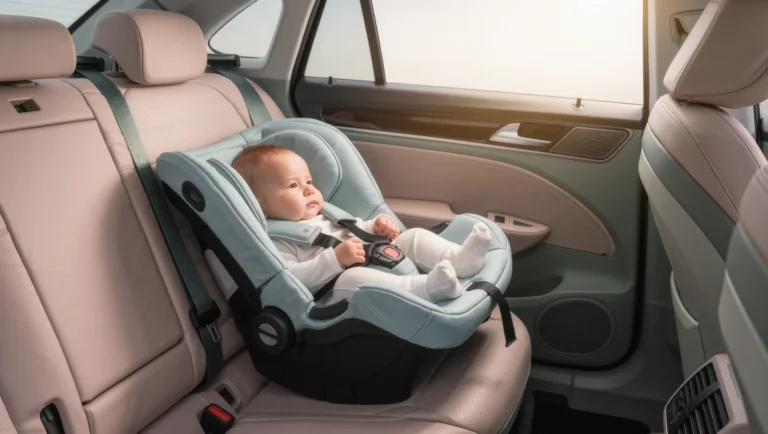
A child is ready for a booster when they have reached the maximum weight or height the manufacturer lists for their harnessed seat. Age alone isn’t the signal. The AAP advises keeping children in a harnessed seat for as long as possible, at least until age 4, and if they outgrow it sooner, looking for a harnessed model with higher weight and height limits.
In other words, a booster isn’t a “big kid” prize. It’s the next step once the current one gets too small. If your child still fits their harnessed seat, there’s no rush.
- Check the label and the manual: they hold the exact limits for your model – not the neighbour, not the forum.
- Height and weight matter more than age: RoSPA (the UK’s Royal Society for the Prevention of Accidents) stresses that these are what decide.
- The approval label: approved seats carry a capital “E” in a circle and “R129” (i-Size) or the older “ECE R44”.
High-back booster or backless booster?
A high-back booster raises your child and has side wings that protect the head in a side impact. A backless booster cushion is cheaper and easier to move between cars, but it doesn’t offer that protection. That’s why RoSPA strongly recommends not removing the back, while the AAP says backless boosters can be used safely only in cars with headrests and high seat backs.
| High-back booster | Backless (booster cushion) | |
|---|---|---|
| Side head protection | Yes, side wings | No |
| Guides the shoulder belt | Yes, shoulder guide | Harder |
| New R129 models | For younger children (usually from about 100 cm) | Only from 125 cm and 22 kg |
| Convenience | Bigger and heavier | Light, easy to swap between cars |
Since 9 February 2017, manufacturers can’t introduce new backless booster models for children shorter than 125 cm or lighter than 22 kg. Existing models haven’t become illegal, but the change shows the direction: for smaller children, the back matters.
Read alsoWhen has your baby outgrown the infant car seat? Calm signsWhen can baby face forward in a carrier: calm, clear guidance
Look for the coloured belt guides. On R129 seats they’re green; on older R44 seats they’re red. If the belt runs right through them, you’re on track. A little game: let your child “find the green” every time. 🟢
How long should a child use a booster seat?
A child stays in a booster until the car’s seat belt fits them properly without it. According to the AAP, this usually happens at around 145 cm (4 ft 9 in) and between 8 and 12 years of age, and most children don’t fit a seat belt alone before 10–12. The legal minimum in the EU is lower, so treat it as a floor, not a goal.
According to the European Commission, children under 1.35 m must use equipment suited to their height and weight. In the UK, the rule is until age 12 or 135 cm, whichever comes first. Individual countries may have stricter rules, so check the law wherever you’re driving.
How do I check if the seat belt fits my child?
Sit your child on the back seat without the booster and buckle up. The belt fits if the shoulder strap crosses the middle of the shoulder and chest, not the neck; if the lap belt sits low on the upper thighs, not the tummy; and if your child can sit all the way back with knees bent at the seat edge for the whole trip. This check is based on AAP guidance.
- Back: your child sits all the way back against the car seat.
- Knees: they bend comfortably at the edge of the seat, without slouching.
- Shoulder: the shoulder belt crosses the middle of the shoulder and chest, away from the neck.
- Thighs: the lap belt lies low and snug across the upper thighs, not the tummy.
- The whole journey: they can stay like this without slipping or tucking the belt behind their back.
If even one point isn’t met, the booster stays a little longer. No big deal – their body just hasn’t grown into a belt designed for adults yet.
Repeat the check at the start of each season and whenever you change cars – belts sit differently in different vehicles. And for long trips, think comfort: a wriggly child quickly pulls the belt out of place. 😉
Can a child in a booster sit in the front seat?
It’s safer for a child in a booster to sit in the back. The AAP advises that all children under 13 ride in the back seat, and RoSPA also names the back as safer, especially if there’s a front passenger airbag. A booster must be used with a three-point belt – across the shoulder and across the lap.
If the back seat has only lap belts, the AAP says not to use a booster; a harnessed seat with higher weight limits is a better fit. There’s more on the front seat and airbags in Baby car seat in the front seat: when it is OK and airbag rules, and on fitting the seat in ISOFIX or seat belt: how to fit your baby’s car seat correctly.
For dads
Make the “belt check” your shared ritual before setting off: shoulder, thighs, back – thumbs up. If your child sees you buckle up every single time, the rule becomes normal, not “just for kids”. And when it’s time for a new seat, let them pick the colour – the deal goes much smoother. 👍
When to get advice
If you’re unsure which seat suits your child and your car, a child car seat specialist in a shop or garage can check the fitting in person. If your child has a health condition that makes sitting with a regular belt difficult, talk to your paediatrician – they know your child and can point you to a suitable solution.
In short
The booster comes when your child outgrows the harnessed seat, and stays until the car’s belt fits on its own – usually somewhere between 8 and 12. Childhood isn’t a race to skip car seats. You’re already doing the most important thing: asking in good time. 💛
Find more practical travel ideas in Travel & Gear, and a plain explanation of the standard in Car seats: i-Size (R129) explained simply.
Sources: AAP / HealthyChildren.org – Car Seats: Information for Families; RoSPA Child Car Seats – Booster Seats; RoSPA Child Car Seats – Booster Cushions; European Commission – Road safety: Children; GOV.UK – Child car seats: the law; GOV.UK – New child car seat rules: no change for existing booster seats.