

ISOFIX and the seat belt are equally safe when the car seat is fitted correctly – that’s the view of the AAP (American Academy of Pediatrics). The difference is ease: ISOFIX makes mistakes harder, while the belt is a great option if your car or seat has no ISOFIX. The safest method is the one you can fit tightly every single time.
Shopping centre car park, light drizzle, and you’re half inside the back seat wrestling a seat belt that refuses to go through the right guide. Your baby watches from the pram, fascinated – best show of the day. 😅
If you’re wondering whether you’re doing something wrong because your seat doesn’t “click” in – don’t worry, you’re fine. The real question isn’t which system is “better”, but whether your seat sits firmly in your car. And that’s something you can master in one afternoon of practice.
ISOFIX or seat belt – which is safer?
According to the AAP, the seat belt and the lower-anchor system (ISOFIX in Europe) are equally safe. You choose one of the two – whichever works best for you, your car seat and your vehicle. ISOFIX simply lowers the chance of error, because the seat plugs into fitting points built into the car at the factory.
RoSPA (the UK’s Royal Society for the Prevention of Accidents) explains why this matters: cars, seat belts and anchor points vary hugely, which makes belt fitting tricky, and surveys consistently find a high proportion of child car seats are fitted incorrectly. ISOFIX removes some of those traps.
| ISOFIX | Car seat belt | |
|---|---|---|
| Safety when fitted correctly | Equal | Equal |
| Risk of mistakes | Lower – it clicks, often with an indicator | Higher – slack belt, wrong guide |
| Compatibility | Only seats approved for your car | Almost any car with a 3-point belt |
| Swapping between cars | Quick if both have ISOFIX | Possible, but needs more care |
| Extra anti-rotation | Top tether or support leg | Depends on the model – check the manual |
The AAP adds one more point: as a rule, use either ISOFIX or the belt – not both – unless the car seat and vehicle manufacturers say it’s OK.
How do I know if my car has ISOFIX?
Look where the back-seat cushion meets the backrest – there are usually small ISOFIX labels, and sometimes the metal bars themselves are visible. The NHS (the UK’s National Health Service) notes they’re often hidden in the gap between the padding. If you can’t find them, check your car’s handbook.
According to RoSPA, ISOFIX has been a legal requirement on all new cars sold in the EU since 2014, but many older cars have the points too. One catch: not every ISOFIX seat fits every ISOFIX car. Seat manufacturers publish vehicle fit lists – check before you buy.
Read alsoCar seats: i-Size (R129) explained simplyBaby on a bike: child bike seat or trailer, and from what age
Take your car with you when you shop. The NHS and RoSPA both suggest trying a few seats in your own car before deciding. Five minutes in the shop car park saves months of frustration. 🚗
How do you fit an ISOFIX car seat step by step?
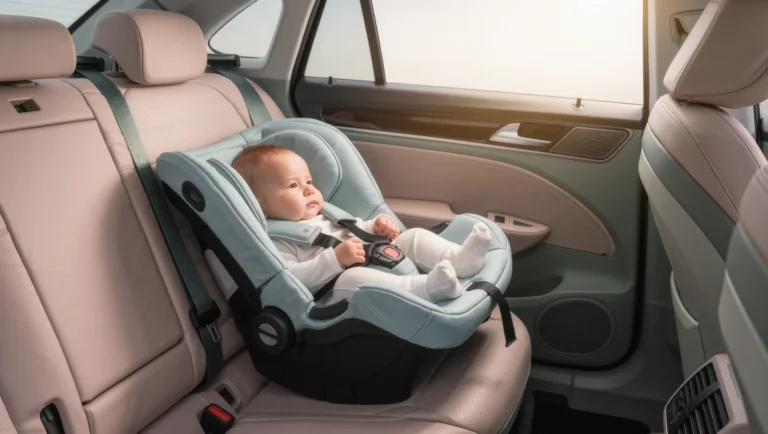
In short: find the points, click the seat’s or base’s two arms into them, then secure the third anchor – a top tether or support leg. Most seats confirm with a click or a green indicator. Here’s the full sequence, following RoSPA’s guidance:
- Find the ISOFIX points in your car – by the labels or the handbook.
- Extend the connectors from the back of the seat or base.
- Push them onto the bars until you hear a click and/or the indicator turns from red to green.
- Attach the top tether to its dedicated anchor – never to a head restraint or luggage hook, they aren’t strong enough.
- Or adjust the support leg so it rests firmly on the floor – and not on the lid of an underfloor storage compartment, which can collapse in a crash.
- Check it’s secure – see the test below.
How do I fit a car seat correctly with a seat belt?
Route the belt exactly through the guides the manufacturer marks, press your weight into the seat and tighten the belt until there’s no slack. Then lock the belt – with the seat’s built-in lock-off or as your car handbook explains. A well-fitted seat barely moves forwards or sideways.
- Guide colours help: according to RoSPA, R44 seats use blue guides for rear-facing and red for forward-facing; i-Size (R129) guides are green.
- No slack: push down with a knee or hand while tightening.
- Lock-off: if your seat has one, make sure it’s locked.
- The buckle shouldn’t rest on the seat frame – RoSPA calls this “buckle crunch”.
To make sense of the R129 label, see Car seats: i-Size (R129) explained simply.
How can I check the car seat is tight enough?
The AAP gives a simple test: hold the seat where the belt or ISOFIX arms go through and give it a wiggle. If it moves more than about an inch (2.5 cm) side to side or front to back, it isn’t tight enough. As for the seat’s own harness, you shouldn’t be able to pinch any slack in the straps over your baby’s shoulders.
Turn it into a two-minute “click-tug-pinch” routine: click, tug the seat sideways, pinch the strap at the shoulder. Like brushing your teeth – soon you’ll do it on autopilot. 👏
Where in the car should the car seat go?
The back is safer. The AAP says the middle of the back seat may be best, but it often has no ISOFIX and the seat can be narrow – then it’s safer to fit the seat on one side where you can get it tight. Most importantly: never put a rear-facing seat in the front if there’s an active passenger airbag.
With winter coming, read Winter Coat in the Car Seat: Staying Warm and Buckled Safely too – bulky coats and snug harnesses aren’t friends.
For dads
Take charge of the “tech department”: read the seat manual and the car handbook, do a practice fit before the birth (the NHS recommends this too) and show anyone who’ll drive your baby – grandparents, friends. If a second car is used, check the fit in that one as well.
In short
ISOFIX and the belt are two paths to the same summit: a seat that sits firm. ISOFIX is the easier path; the belt is a perfectly reliable alternative as long as it’s tight. Do the test, repeat it now and then – and set off calmly. You’re the best pilot your little passenger could have. 💛
Find more travel ideas in Travel & Gear. Sources: AAP/HealthyChildren.org, RoSPA (childcarseats.org.uk), NHS.
Sources: AAP / HealthyChildren.org – Car Seat Installation Information: Seat Belts & LATCH; AAP / HealthyChildren.org – Car Safety Seats: Information for Families; RoSPA – Isofix Seats (childcarseats.org.uk); RoSPA – Fitting Child Car Seats (childcarseats.org.uk); NHS – Choosing a baby car seat.