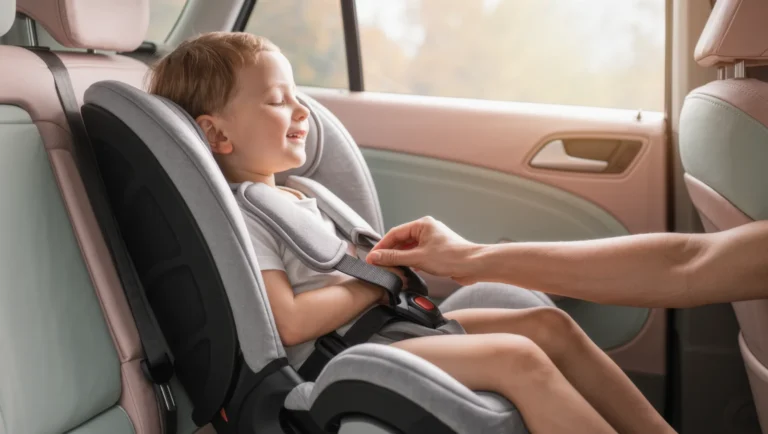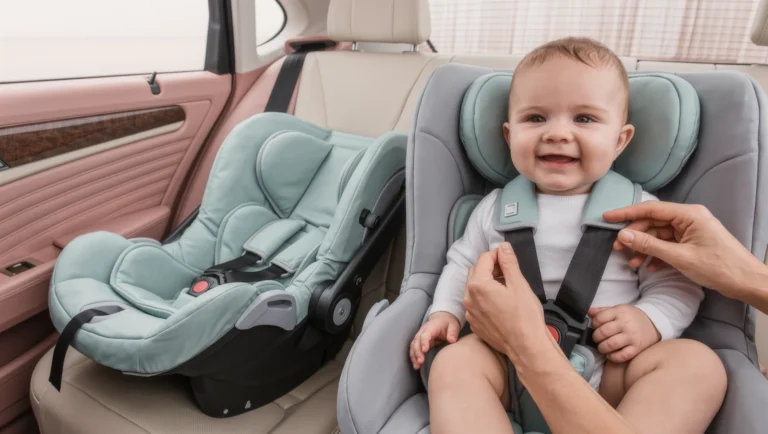


A rear-facing baby car seat can go in the front passenger seat only if the airbag in front of it is switched off. That is the rule across the EU. Even so, the back seat is still the safest place for your baby.
You are driving alone with the baby. They are in the back, you are at the wheel, and every little whimper makes you want to twist around. 😅 Then the thought pops up: “What if I put them next to me, in the front? I could see them, soothe them…”
That thought makes total sense – you want to be close. No need to worry for thinking it. The good news: the rules here are clear and easy to follow, and in a minute you will know them by heart.
Can a baby car seat go in the front seat?
Yes, but with one firm condition: if the seat is rear-facing, the front passenger airbag must be switched off. EU Directive 2003/20/EC bans rear-facing child seats in a seat protected by an active front airbag. The back seat remains the safest spot.
The AAP (American Academy of Pediatrics) goes further: if your car has a front passenger airbag, babies in rear-facing seats must ride in the back. It says the back seat is the safest place for all children under 13. The front seat is really a fallback for special cases, such as a car with no back seats.
Why is an airbag a problem for a rear-facing seat?
Because in a rear-facing seat, your baby’s head sits right where the airbag opens. According to Child Car Seats (the website of the UK safety charity RoSPA), an airbag fully inflates in less than a second and with huge force. It is designed to protect an adult, not a car seat.
The AAP notes that even in a relatively low-speed crash, the airbag can inflate, strike the car seat and seriously injure the baby. For an adult the airbag is a lifesaver; for a baby in a rear-facing seat right in front of it, it is not. So this rule is not a matter of preference – it is physics.
How do you switch off the passenger airbag properly?
If your baby really has to ride in front, first switch off the front passenger airbag as your car’s manual describes. Only then fit the car seat. UK rules (GOV.UK) require exactly this: the airbag is deactivated before a rear-facing seat goes in the front.
Read alsoBaby on a bike: child bike seat or trailer, and from what ageISOFIX or seat belt: how to fit your baby’s car seat correctly
- Open your car manual: it tells you whether and how the airbag can be switched off (often a key switch on the side of the dashboard or a menu setting).
- Switch it off before fitting: not after your baby is already buckled in.
- Check the indicator: most cars show a “Passenger airbag off” light – make sure it is on.
- Fit the car seat by its instructions: with Isofix or the seat belt, as the manufacturer says.
- Switch it back on when an adult sits in front – a switched-off airbag protects no one.
If your car has no way to switch off the airbag, a rear-facing seat does not belong in the front. It rides in the back, no exceptions. More on fitting itself in ISOFIX or seat belt: how to fit your baby’s car seat correctly.
Set a phone reminder – “Is the airbag back on?” – for days when an adult sits in front. Sounds silly, but this is exactly the step that is easiest to forget. 🙂
What about a forward-facing seat in the front?
It is possible, but only when there is no other choice. Child Car Seats advises a forward-facing seat in the front only as a last resort: vehicle seat pushed as far back as possible, child securely buckled and as far from the dashboard as possible. The back is still safer.
| Type of seat | Front, airbag active | Front, airbag off | Back seat |
|---|---|---|---|
| Rear-facing (infant carrier, baby seat) | No – banned in the EU | Allowed | Safest |
| Forward-facing | Only if no other choice, seat pushed fully back | Check your car manual | Safest |
In the UK, height-based seats (R129, i-Size) must stay rear-facing until your child is over 15 months old. For more on the standard, see Car seats: i-Size (R129) explained simply.
What about side airbags in the back?
Side curtain airbags are usually not a problem for a child in the back. Child Car Seats explains that they drop down to protect the head and are less powerful than front airbags, so they tend to add protection. Still, the AAP suggests checking your car seat instructions and car manual about positions next to side airbags.
A mirror on the back headrest lets you see your baby in the rear-view mirror without turning around. More peace of mind for you, and they stay in the safest spot. 💛
For dads
Fitting the car seat and handling the airbag switch make a great “dad mission”. Read both manuals (car and car seat), practise the fitting once when nobody is in a hurry, and show everyone who drives the car where the airbag switch is. Five minutes of work that saves a lot of second-guessing on busy mornings.
In short
Rear-facing in front only with the airbag off – and even then, the back seat stays the best place. You do not need to remember ten rules, just one: “Rear-facing in front of an airbag – never.” You care about the details, which means you are already doing brilliantly. 🚗💛
Find more ideas for calm trips in Travel & Gear. Sources: EU Directive 2003/20/EC, the AAP (healthychildren.org), GOV.UK and Child Car Seats (RoSPA) – see the list below.
Sources: EU – Directive 2003/20/EC (compulsory use of safety belts and child restraints); AAP / HealthyChildren.org – Air Bag Safety for Children; GOV.UK – Child car seats: the law; Child Car Seats (RoSPA) – Airbags and Child Seats.