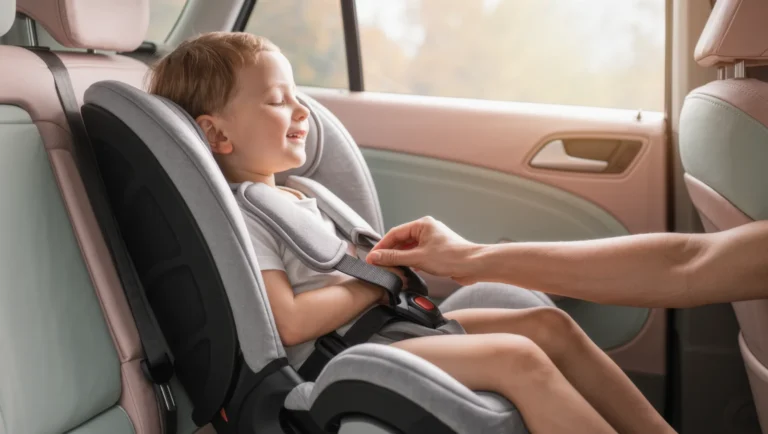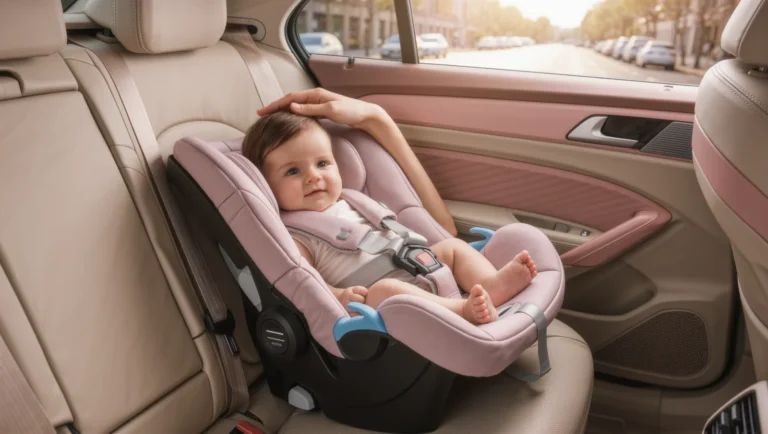


Your baby has outgrown the infant car seat when they reach the maximum weight or height set by the manufacturer (whichever comes first), or when the top of their head is above the top of the seat. Age on its own isn’t the signal. The next step is a bigger seat in which your baby keeps riding rear-facing.
It’s morning, you’re buckling up, and suddenly you notice the little feet pressing against the seat and the head almost reaching the edge. The infant carrier that looked enormous yesterday now looks like a shoe one size too small. 😅
If you’re wondering “is it time, or am I imagining things?” – that’s completely understandable. Labels come in tiny print, online advice disagrees, and every friend has “their” month. Don’t worry, it’s all fine: the answer is simpler than it seems, and you’re holding it in your hands – in the manual and on the seat itself.
When has my baby outgrown the infant car seat?
The infant seat is too small when at least one of three things is true: your baby has reached the maximum weight, your baby has reached the maximum height on the label, or the top of their head is above the top of the seat. One sign is enough – you don’t wait for all three. The exact limits are in your model’s manual.
- Weight: for seats under the older R44 standard, group 0+ goes up to 13 kg, according to GOV.UK (the UK government).
- Height: for i-Size seats (the R129 standard) the limit is based on height and is printed on the label.
- The head: according to RoSPA’s child car seats website (the UK accident-prevention charity), a seat has usually been outgrown when the top of the child’s head is above the top of the seat.
- The harness: if the straps can no longer be positioned correctly in relation to the shoulders, it’s time to check the manual.
Take a photo of the label on the side of the seat and add it to your favourites album. That way, in the shop or during a quick check in the car, you’re not digging for the manual under the seat. 📸
Is it age, or height and weight, that decides?
Height and weight decide, not age. One baby may outgrow the infant seat at 9 months, another only after their first birthday. The AAP (American Academy of Pediatrics) notes that rear-facing-only seats have different limits depending on the model, so compare your baby with the label, not with the neighbours’ baby.
There’s also a myth that makes many parents rush: feet touching the vehicle seat are not a sign that the car seat is too small. The AAP explains that children are very flexible and easily find a comfortable position, and leg injuries in rear-facing children are very rare.
Read alsoCar journeys with a baby: breaks, car seats and calmWhen can baby face forward in a carrier: calm, clear guidance
Infant carrier or the next seat: what’s the difference?
The infant carrier is light, has a handle and often clicks into a base that stays in the car. The next seat is bigger, stays installed and lets your child ride rear-facing for longer, because it has higher weight and height limits. According to the AAP, many such seats allow rear-facing for 2 years or more.
| Type | How it’s used | Convenience |
|---|---|---|
| Infant carrier (rear-facing-only) | Rear-facing only, from the very first ride | Portable, clicks into a base |
| Extended rear-facing seat | Rear-facing to a higher weight (according to RoSPA, up to 18 kg or even 25 kg for some models) | Bigger, stays in the car |
| Convertible / all-in-one | Rear-facing first, forward-facing later | Lasts a long time, but bulky |
If you’re wondering what R129 and i-Size mean, see Car seats: i-Size (R129) explained simply.
Should my baby keep riding rear-facing?
Yes – switching from the infant carrier doesn’t mean turning forward. The AAP advises that children ride rear-facing for as long as possible, until they reach the highest weight or height allowed by the seat. According to GOV.UK, with R129 seats a child rides rear-facing until they are over 15 months old. The reason: rear-facing seats better protect the head, neck and spine.
RoSPA’s site notes that a rear-facing baby seat reduces the risk of death or injury in a crash by 90% compared with being unrestrained. That’s why a bigger rear-facing seat is the natural next step after the infant carrier.
How do I make the switch, step by step?
- Check the label and manual of your current infant seat: weight, height and guidance on the head.
- Choose a seat that installs rear-facing and fits your baby’s height and weight. Try it in your car before you buy – not every seat fits every car.
- Install it following the manual – with Isofix or with the car’s seat belt. If you’re unsure which suits you, see ISOFIX or seat belt: how to fit your baby’s car seat correctly.
- Test the installation: the AAP says that if the seat moves more than an inch (about 2.5 cm) side to side or front to back at the belt path, it isn’t tight enough.
- Adjust the harness: for rear-facing, the straps sit at or just below the shoulders. You shouldn’t be able to pinch any slack in the strap between your fingers.
- Check the angle: your baby’s head shouldn’t flop forward. All rear-facing seats have a recline indicator.
Never put a rear-facing seat in the front seat with an active airbag. If your car is older and you can’t remember how to switch it off – that’s the perfect excuse to leaf through the car’s handbook with a cup of coffee. ☕
In winter, keep an eye on clothing too: a thick coat loosens the harness. Details in Winter Coat in the Car Seat: Staying Warm and Buckled Safely.
Can I use the infant carrier outside the car?
The infant carrier is made for travel, not for long sleeps at home. The AAP states that car seats should be used only for travel, not for sleeping, feeding or other use outside the vehicle. If your baby nods off on the way – no big deal, just move them to a flat sleep surface when you arrive.
For dads
Installing the new seat is a great “mission” for you. Read the manual once all the way through (yes, really all of it), install, give it a shake at the belt path and check the recline indicator. Then show everyone who drives the baby – grandparents, the babysitter – how to buckle up properly. Five minutes of your time, years of peace of mind for everyone.
In short
The infant carrier is outgrown when your baby reaches its weight or height limit, or when their head passes the top edge – not at a particular month. The next step is a bigger seat, rear-facing again. You’re the most careful pilot in that car – and your baby can feel it. 💛
More travel ideas are waiting in Travel & Gear.
Sources: AAP / HealthyChildren.org – Car Seats: Information for Families; RoSPA Child Car Seats – Rearward-facing Seats; GOV.UK – Child car seats: the rules.