

According to the NHS (the UK’s National Health Service) and the AAP (American Academy of Pediatrics), cow’s milk can become your child’s main drink from around 12 months. Before that, the main drink is breast milk or formula, but a little cow’s milk in food is fine from around 6 months.
The first birthday is coming. You’ve got the candle, the balloon and the cake, and now you’re standing at the dairy fridge wondering: “So… straight from the carton?” 😊
If you feel a bit confused, that’s completely understandable. Everyone says something different, and the packaging says even more. Don’t worry, it’s all fine: the rules here are pretty simple, and we’ll go through them together.
When can babies drink cow’s milk?
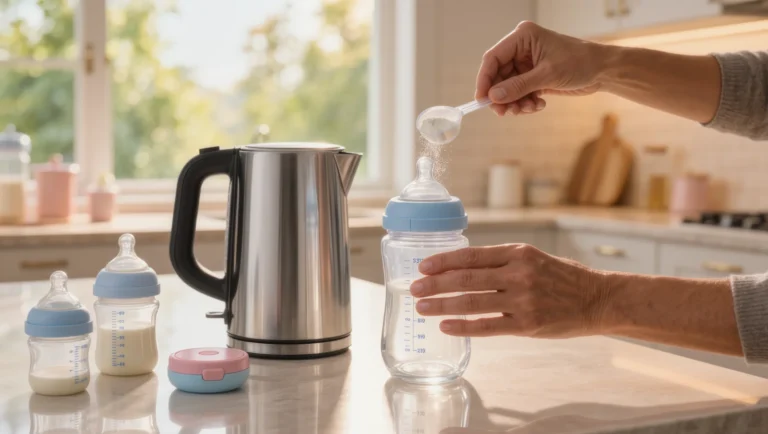
As a main drink, from around 12 months. That’s what both the NHS and the AAP say. Before the first birthday, the main drink should be breast milk or infant formula. Pasteurised cow’s milk can be used in cooking or mixed into food from around 6 months, for example in porridge or a purée.
So the difference is between “a splash in the bowl” and “a cup of milk instead of formula”. The first is fine from the start of weaning, the second once your baby turns one.
Why not before 12 months?
Because cow’s milk doesn’t have the right balance of nutrients a baby needs in the first year. According to the NHS, infant formula is the only suitable alternative to breast milk in the first 12 months, and cow’s, goat’s and sheep’s milk don’t contain enough iron and other nutrients for this age.
After the first birthday things change: your child is eating a varied diet and gets much of their nutrition from food. Milk becomes a side act rather than the main show.
How do you switch from formula to cow’s milk?
No complicated plan needed. Around the first birthday you can offer pasteurised whole cow’s milk as the main drink, ideally from a cup. If you’re breastfeeding, you can carry on for as long as you both want – cow’s milk isn’t a required replacement for breast milk.
- From around 6 months: a little cow’s milk in food (porridge, purées, cooking) – the NHS says this is fine.
- Around 12 months: offer pasteurised whole milk as a drink.
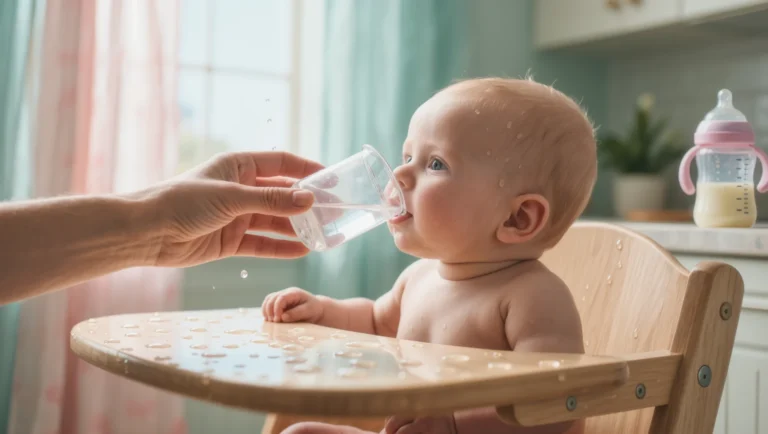
- In a cup, not a bottle: the NHS advises discouraging bottle feeding once your baby is 1. An open cup is kinder to teeth. More in our guide When can a baby drink from a cup? Bottle to cup without drama.
- No special “growing-up” milks: the NHS and AAP say formula milks, including follow-on and toddler milks, aren’t needed after 12 months for most children.
As a rough guide, the AAP suggests about 2 cups (16 oz, around 470 ml) of cow’s milk a day for children aged 12 to 24 months. Curious how much milk your baby drinks before that? See How Much Milk Does Your Baby Need, Month by Month.
Read alsoHow Much Milk Does Your Baby Need, Month by MonthWhen can babies drink water? A calm guide by age
If your little one eyes the cup suspiciously, pour the milk into their favourite cup and drink from yours at the same time. It becomes a ritual, not “that weird new milk”. Copying you works wonders. 🥛
Which milk: whole, skimmed or plant-based?
For children aged 1 to 2, the AAP advises whole milk. The NHS allows whole and semi-skimmed milk from age 1, but not skimmed or 1% milk as a main drink before age 5, because they don’t contain enough calories. On plant-based drinks the two sources differ, so this is a good one to ask your paediatrician about.
| Type of milk | What the sources say |
|---|---|
| Whole cow’s milk (pasteurised) | Main drink from 12 months (NHS, AAP); in food from around 6 months (NHS) |
| Semi-skimmed | NHS: from age 1. AAP: whole milk until age 2, then lower-fat |
| Skimmed and 1% | NHS: not as a main drink before age 5, but fine in cooking from age 1 |
| Goat’s and sheep’s milk (pasteurised) | NHS: as a main drink from age 1, not before |
| Soya, oat, almond drinks | NHS: unsweetened and calcium-fortified, from age 1 as part of a balanced diet. AAP: of plant-based milks, only soy milk is nutritionally equivalent to cow’s milk |
| Rice drink | NHS: not for children under 5 because of arsenic levels |
| Unpasteurised milk | NHS: not for young children because of the higher risk of food poisoning |
At the shop, look for “pasteurised” and “whole” on the label. Save flavoured milk (chocolate, strawberry) for later – the AAP advises avoiding added sugars before age 2. 😉
For dads
The morning cup of milk can be your thing together. Sit at the table, you with your coffee, them with their milk, and say “cheers”. It sounds small, but moments like this turn something new into a habit.
When should you ask your paediatrician?
Most children move to cow’s milk without any trouble. Get in touch with your paediatrician if:
- You suspect an allergy or intolerance: for example a rash, vomiting or tummy problems after dairy. The NHS advises talking to your GP or health visitor about a suitable alternative.
- Your child is on a special formula: if it was prescribed, the doctor will tell you how and when to change.
- You’re considering a plant-based drink instead of cow’s milk: your paediatrician can check your child is getting everything they need from food.
- Your child refuses almost all milk and food: for peace of mind, it’s worth checking they’re growing well.
Talk to your paediatrician or doctor before changing anything. They know your child and will help you choose what suits them best.
In short
Cow’s milk is like a key handed over on the first birthday: a little in food from around 6 months, a main drink from around one. Whole, pasteurised, in a cup – and you’re on the right track. You’re doing better than you think. 💛
Information based on the NHS and the AAP (healthychildren.org). The full list of sources is below. More feeding ideas in Baby Feeding.
Sources: NHS – Drinks and cups for babies and young children; AAP (HealthyChildren.org) – Recommended Drinks for Children Age 5 & Younger; AAP (HealthyChildren.org) – Why Most Toddlers Don't Need Toddler Formula (2023).