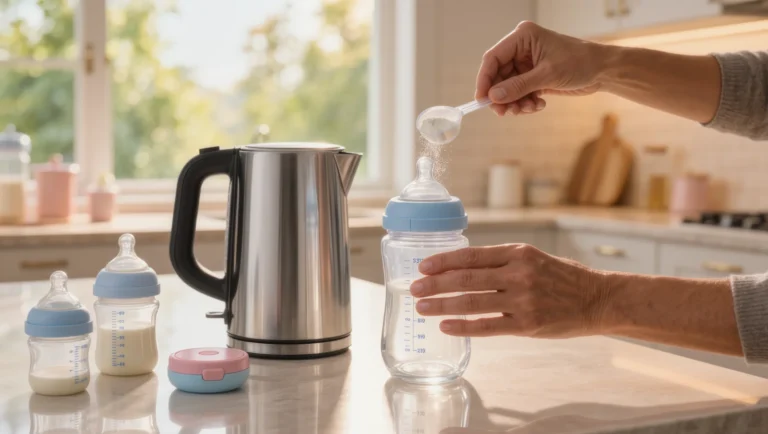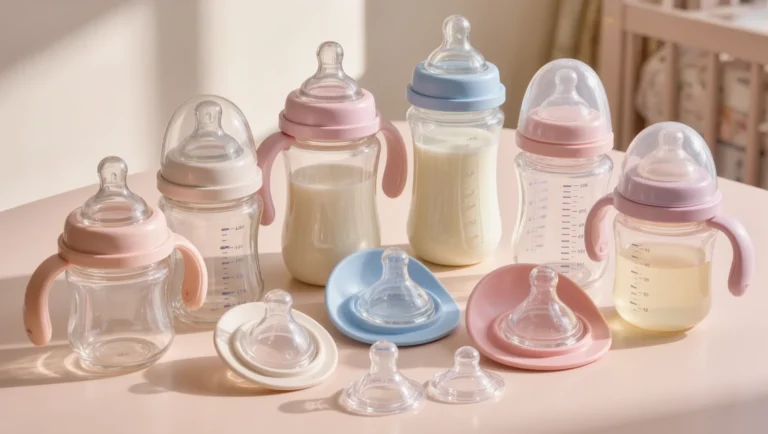


Your baby can start drinking from a cup from around 6 months, when they start solid foods. The NHS (the UK’s national health service) says bottles are best left behind after the first birthday, while the AAP (American Academy of Pediatrics) says the switch is usually complete somewhere between 12 and 18 months.
You’re sitting by the high chair, offering that lovely new cup, and your baby… tips it over themselves, grins triumphantly and reaches for the bottle. 😅 Half the water is on the bib, the other half on the floor.
If that sounds familiar – relax, everything is fine. Drinking from a cup is a skill learned just like walking: lots of tries, lots of spills and plenty of laughs. Nobody nails it the first time.
And one more thing: there’s no exact day when it “has to” happen. There are guideposts, and you and your baby will find your own pace.
When can a baby start drinking from a cup?
A cup can appear at around 6 months, together with first solid foods. The NHS advises offering sips of water from a cup with meals from this age. The AAP also recommends offering a cup when your baby starts eating solids – usually around 6 months.
At first the goal isn’t for your baby to actually drink much, but to get to know the cup: touch it, tilt it, try it. For more about water, see When can babies drink water? A calm guide by age.
The AAP has another idea: at first, put the milk your baby already drinks in the cup – breast milk or formula. A familiar taste makes the new thing feel less strange.
Open cup, spouted cup or straw cup – which one to choose?
The NHS says an open cup or a free-flow cup (without a non-spill valve) helps your baby learn to sip rather than suck, and is better for their teeth. The AAP adds that if you choose a spouted sippy cup, it should have no valve, because with a valve children still suck – almost like from a bottle.
| Type of cup | What the sources say | Handy if… |
|---|---|---|
| Open cup | NHS: helps learn to sip; better for teeth | you don’t mind a few spills and keep a cloth nearby |
| Spouted cup, no valve | NHS and AAP: better than a bottle or a cup with a teat | you want an in-between step with fewer wet clothes |
| Straw cup | AAP: also an option while learning | your baby likes the straw and manages it |
| Non-spill valve cup | AAP: children suck as from a bottle – doesn’t help learning | best avoided as the main cup |
The AAP stresses that a sippy cup is only an optional step: many children go straight from breast or bottle to a regular cup. For choosing a bottle while you still use one, see How to Choose a Baby Bottle and Teat.
Read alsoWhen can babies drink cow’s milk? Calm, clear guidanceWhen can babies drink water? A calm guide by age
Look for a cup with two handles – the AAP suggests them because they’re easier for little hands. A weighted base that pops the cup back upright saves you a puddle or two. And under the high chair? An old towel. It’s your best friend this month. 🌿
When should a baby stop using a bottle?
The NHS advises that feeding from a bottle should be discouraged once your baby is 1 year old, and the AAP says the transition is gradually completed between 12 and 18 months. Both agree on the direction: the cup becomes the main way to drink around the first birthday, without an abrupt change.
| Age | Guidepost | Source |
|---|---|---|
| around 6 months | first cup, sips of water with meals | NHS, AAP |
| around 1 year | bottle feeding discouraged | NHS |
| 12–18 months | switch from bottle to cup completed | AAP |
| around 2 years | drinking from an open cup | AAP |
Why move on at all? The NHS explains that drinks flow slowly through a teat, so anything sugary stays in contact with the teeth for longer. That’s why a bottle or trainer cup should only hold breast milk, formula or water, with nothing added. The AAP adds that little ones who sip from bottles all day often aren’t hungry at mealtimes.
How do you wean a baby off the bottle, step by step?
It’s easiest to go gradually: drop the bottles that matter least first and the bedtime one last. The AAP suggests keeping the bottle only at mealtimes at first, then slowly phasing it out at other times too, including naps and bedtime, with comfort coming from cuddles and a story instead.
- Put the cup on the table next to the plate at every meal – as something normal, no pressure.
- Start with the familiar: milk in the cup, then water too.
- Drop one bottle at a time – daytime first, bedtime last. Leave a few days between steps.
- Swap the comfort: the bedtime bottle becomes a cuddle, a song or a book.
- Tell everyone – grandparents, sitter, nursery. The AAP advises all caregivers to follow the same routine so you don’t slide back.
- Praise every sip. Seriously – applause works. 👏
Drink water from your own cup when you eat together. Babies are the world’s best copycats – if mum and dad drink “like grown-ups”, they’ll want to as well. 😊
Is it normal for a baby to refuse a cup?
Yes, completely normal. The AAP writes that pouting, protests and even tears over a new cup are to be expected – little humans don’t like letting go of familiar habits any more than we do, and the bottle is a comfort. Refusing doesn’t mean you’re doing anything wrong. It just takes patience and time.
If today was a no – try again tomorrow. Maybe they just weren’t thirsty. Leave the cup on the table and don’t turn every sip into an exam.
For dads
Take on “mission cup”: you’re the one who sits with your baby at breakfast and drinks water from your own cup, with obvious enjoyment. And when the bedtime bottle goes, you take over the new ritual – a book, a song, a cuddle. Mum gets a break, and your baby learns that comfort comes from you too. 💛
When to ask your pediatrician
The AAP advises talking to your pediatrician if resistance turns into a real power struggle you can’t resolve. Ask too if your child has a chronic illness, a physical difference or a developmental delay that might make the switch harder – the doctor can help you make a plan that fits their abilities. And if you suspect a problem with their teeth, the NHS advises seeing a dentist as soon as possible. Your pediatrician knows your baby and will support you both.
In short
The cup arrives around 6 months, and the bottle leaves gradually around the first birthday – a little earlier or later, but without a sudden stop. Spilled milk is part of the lesson, not a failure. Every sip is a small win, and you’re the best coach your baby could have. 💛
You’ll find more feeding ideas in the Baby Feeding category.
Sources: NHS – Drinks and cups for babies and young children; AAP / HealthyChildren.org – From Bottle to Cup: Helping Your Child Make a Healthy Transition; NHS Best Start in Life – How to take care of your baby or toddler's teeth.