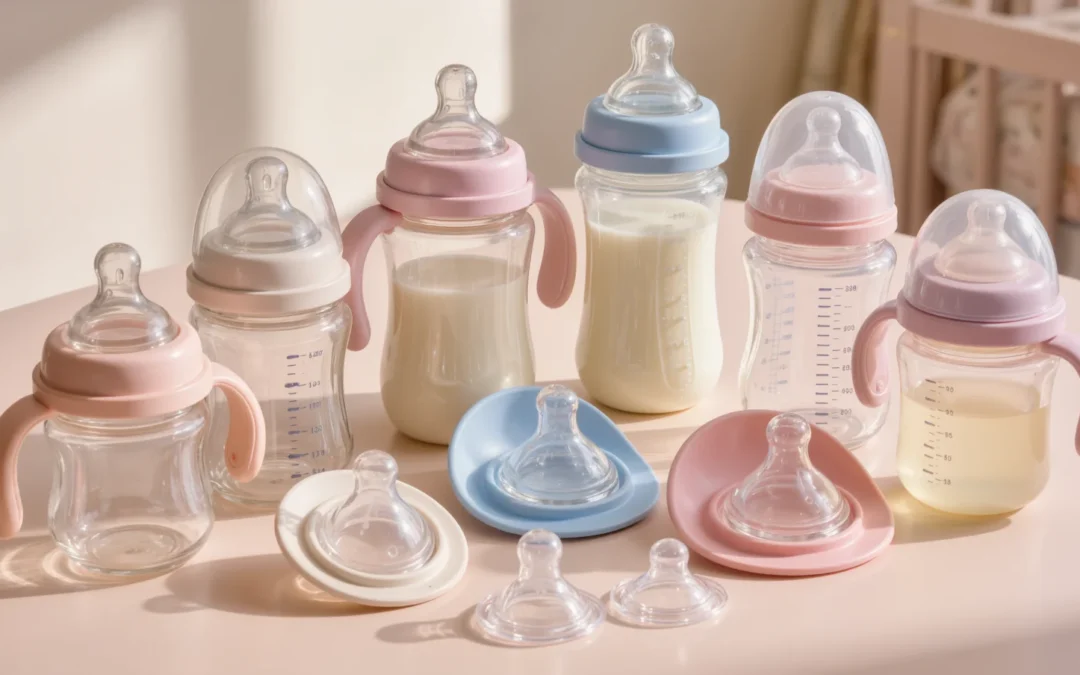
You walk into the shop for one bottle and find yourself facing a wall of shapes, colours and promises – “anti-colic”, “just like the breast”, “ergonomic”. If your head is spinning, that’s normal. The good news: there’s no one “right” bottle. There’s the bottle that suits your baby and your life.
The short answer: Paediatricians find no good evidence behind brands’ claims, so don’t overthink it. Choose the material you prefer and the slowest teat flow your baby manages well. Gagging or coughing suggests the flow is too fast, and tiring and getting fussy suggests it’s too slow.
What do paediatricians say?
The American Academy of Pediatrics (AAP) is pretty frank: there’s no good scientific evidence to back up individual brands’ advertising claims. What matters more than the type of bottle is how you hold your baby during a feed. Some NHS hospitals also stress that no teat is like the breast, whatever the adverts say.
So breathe – you can’t get this fatally wrong. At worst, you’ll switch teats after a week. 😊
What material should the bottle be?
- Plastic – light, unbreakable, affordable. Over time it can get scratched, and then it’s best to replace it.
- Glass – easy to clean and doesn’t hold on to smells, but it’s heavier and can break. Silicone sleeves help with grip.
- Silicone and stainless steel – unbreakable and durable, but usually more expensive.
And what’s BPA? Bisphenol A is a substance that used to be found in some types of hard plastic. In the EU it has been banned in baby bottles since 2011, and a new regulation from the start of 2025 extended the ban to other harmful bisphenols in food-contact materials. Because the legislation also allows a transition period, for old or hand-me-down bottles the AAP advises avoiding clear hard plastic marked “7” and “PC”, and not heating plastic bottles in the microwave.
Before filling your basket, buy two different teats and hold a little “tasting session”. The judge is strict but fair. 😉
How to choose a teat
The real hero here is the flow – how fast the milk comes out. NHS materials recommend choosing the slowest flow your baby manages well. Newborns usually start with a slow flow (often marked “1”).
Signs the flow is too fast: your baby gags, coughs, milk dribbles out of their mouth or they get agitated. Signs it’s too slow: they suck for a very long time, get tired and fussy.
Shapes vary – standard, orthodontic, wide-neck. The material is silicone (clear) or latex (brown). The AAP’s advice is simple: use the one your baby accepts. If someone in the family is allergic to latex, silicone is the logical choice.
What matters most to you?
- If easy cleaning matters to you → look at wide-neck bottles with few parts.
- If you’re often out and about → a lighter, unbreakable bottle.
- If you’re combining with breastfeeding → slow flow and so-called paced feeding (see below).
- If you’re thinking long-term → glass or steel.
You don’t have to buy whole sets at once. One or two bottles to try out save quite a lot of money – and nerves. Later, if you’re exclusively bottle-feeding, one NHS guide suggests about six bottles so you always have a clean one to hand.
After each sterilisation, hold the teat up to the light and give it a gentle tug. If it’s sticky or cracked – time for a new one.
What is paced (responsive) bottle feeding?
It’s a way of bottle-feeding where your baby sets the pace. You hold them fairly upright and the bottle almost horizontal, tilted just enough to keep the teat full of milk. You touch their top lip with the teat and wait for your baby to take it in themselves. According to the NHS, this gives your baby time to sense that they’re full and lowers the risk of overfeeding.
For the dads
If you’re the one who often gives the bottle, you’re also the best teat tester. Make a note of how your baby gets on with each one – observations like these are gold when choosing.
Safety first
- Check teats regularly. If they’re cracked, torn or sticky – replace them.
- Don’t prop the bottle up with a pillow and don’t leave your baby alone with it.
- Buy from reputable retailers – that way you can be more confident the product meets European requirements.
In short
The perfect bottle isn’t bought, it’s discovered – with a little observation and a little patience. If the first try doesn’t work out, that’s not a mistake, just information. You know your baby best, and you’ll find the right one. 🍼
Sources: HealthyChildren.org (AAP) – Bottle Feeding Basics; HealthyChildren.org (AAP) – Baby Bottles, BPA and Phthalates; Cambridge University Hospitals NHS – Bottle feeding; European Commission – EU prohibition on Bisphenol A from 20 January 2025.
More from this section


Your baby, week by week
Once a week: what's coming up, one useful tip and nothing extra.