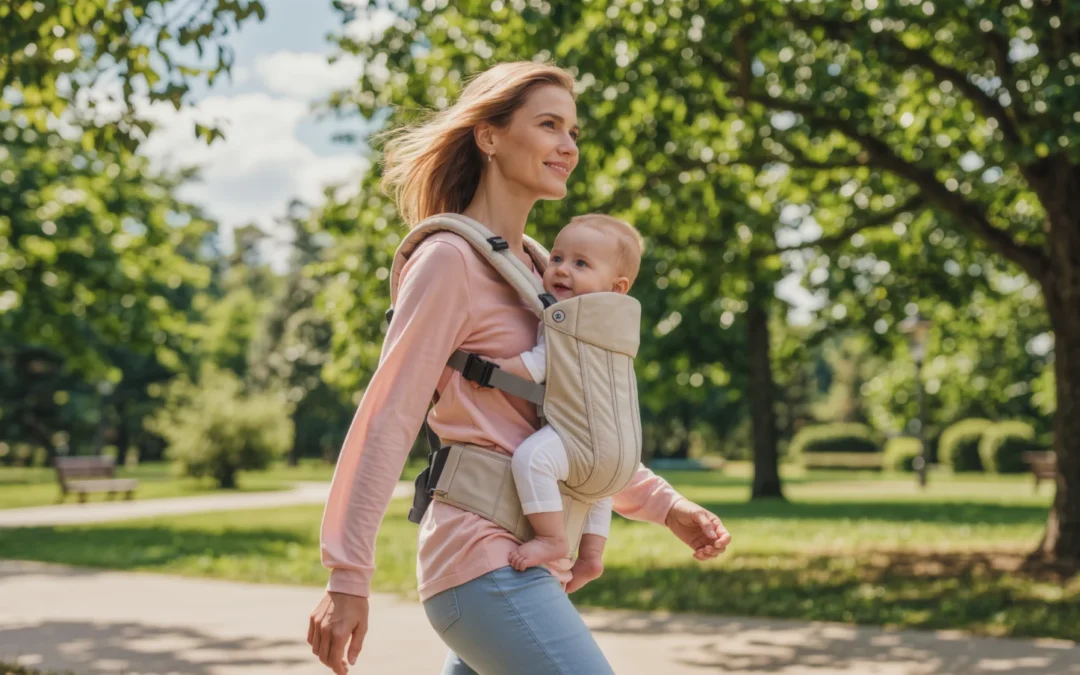
Your hands are free, your baby is breathing peacefully against your chest, and you’re drinking your coffee while it’s still hot. Sounds like a dream? With the right carrier, it’s often completely real.
The problem is that the choice is huge: wraps, carriers, rings, buckles. The good news is that there’s no single right carrier. There are two simple safety rules – and after that, you choose what suits you.
The short answer: A long wrap suits a newborn if you don’t mind some practice, and a buckle carrier suits speed and simplicity. Whichever you choose, keep the legs in the M position with the fabric from knee to knee, and follow the TICKS checklist.
What’s the difference between a sling and a carrier?
- Stretchy or woven wrap (a long piece of fabric) – soft, fits snugly to your body and is cosy for newborns. It takes a little practice before tying it feels natural.
- Ring sling – quick to put on and take off, handy for short trips. But the weight sits on one shoulder.
- Soft tie carrier (meh dai style) – something in between: fabric in a carrier shape, with no buckles.
- Ergonomic buckle carrier – quick to put on, easy to swap between parents, often with a padded waist belt. It’s bulkier and usually has a minimum height or weight it can be used from.
What is the “M position”?
It’s the natural position of a baby’s legs: knees higher than the bottom, thighs slightly spread and supported. From the side, the shape really does look like the letter M.
The International Hip Dysplasia Institute (IHDI) explains that this position supports healthy hip development. The opposite – legs dangling straight and pressed together, for long periods and often – isn’t a good idea. In practice: the fabric should reach from one knee to the other.
Do a quick check in the mirror: can you see their face, can you kiss their forehead, are their knees higher than their bottom? Three yeses – and you’re ready to go. 😊
The TICKS rule – five letters for peace of mind
This is a short checklist created by the UK Sling Consortium (a group of British sling makers and retailers) and also recommended by the charity The Lullaby Trust:
- T – Tight: your baby is held snugly against you, without slumping down.
- I – In view at all times: you can see their face just by glancing down.
- C – Close enough to kiss: you can easily reach the top of their head with your lips.
- K – Keep chin off chest: that keeps their airway clear.
- S – Supported back: their back is in its natural shape, with their tummy and chest against you.
If your baby was born prematurely, with a low birth weight or has breathing difficulties, ask your paediatrician before the first time you carry them. And for feeding, it’s more relaxed to take your baby out of the carrier.
How to choose: what matters most to you?
- If you want maximum softness for a newborn and don’t mind a bit of practice → a long wrap.
- If speed and simplicity matter most → an ergonomic buckle carrier.
- If you’ll both be carrying and you’re very different heights → look for easy strap adjustment.
- If you have a sensitive back → wide shoulder straps and a waist belt make a difference.
Whatever you choose, check that it allows the M position and that it’s suitable for your baby’s age and weight. If you can, try before you buy – in a shop or with a babywearing consultant.
For the dads
Babywearing isn’t just a mum thing. For many dads it’s the quickest way to calm a fussy baby – and to feel genuinely strong. Adjust the straps for yourself and run through TICKS every time.
In short
Sling or carrier – both can be a great choice, as long as they allow the M position and you remember the five letters. The first few times you might feel clumsy. By the tenth, you’ll be doing it after midnight, in the dark, with a smile. You’ve got everything you need. 💛
Sources: International Hip Dysplasia Institute – Baby Carriers & Other Equipment; The Lullaby Trust – How to use baby slings and carriers safely; NCT – Which baby carrier or sling is best for me?.
More from this section
Your baby, week by week
Once a week: what's coming up, one useful tip and nothing extra.