
This guide may contain affiliate links. If you buy through them, we may earn a small commission at no extra cost to you. Learn more
“3-in-1” sounds like a shampoo, “2-in-1” like vending-machine coffee, and “lightweight stroller” like something you definitely want. Here’s what’s hiding behind those names – and how to work out which one suits you.
There’s no wrong answer. There are different families, different towns and different budgets.
The short answer: A 3-in-1 has one frame with a carrycot, a seat and an infant car seat. A 2-in-1 has the carrycot and seat, with the car seat chosen separately. A lightweight stroller is compact, but most are for babies who can already sit up steadily. Newborns need a firm, flat base, so a carrycot matters at the start.
What is a 3-in-1 pram?
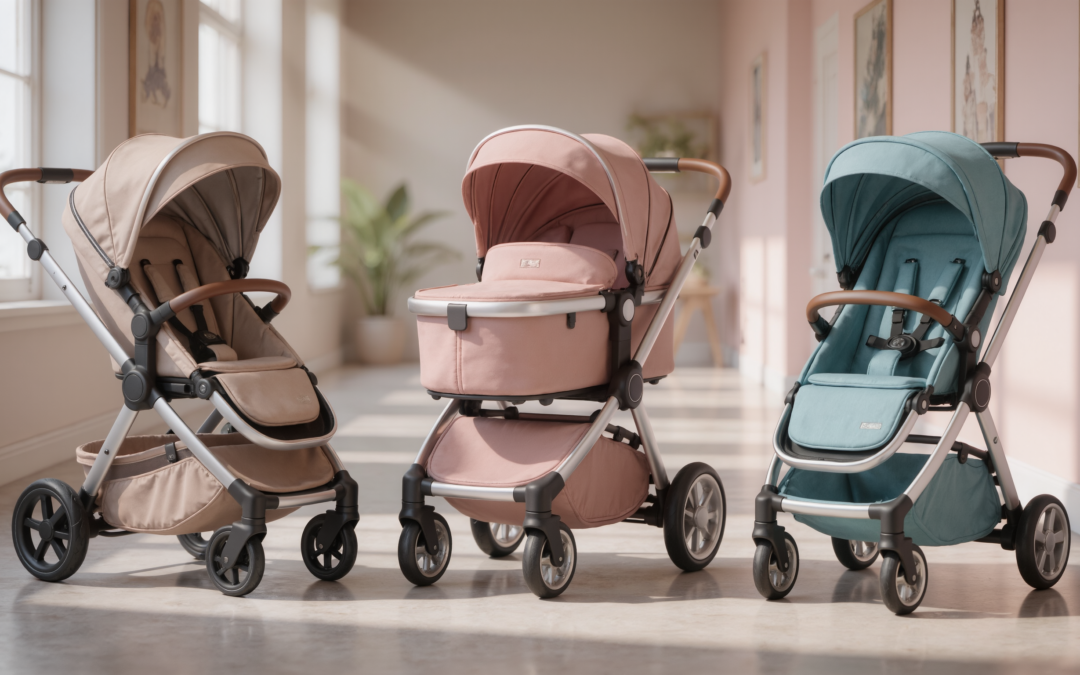
It’s a whole system with one frame and three interchangeable parts (often called a travel system):
- a carrycot – a flat bed for the littlest ones;
- a pushchair seat – for later, once your baby can sit up;
- an infant car seat that also clips onto the frame.
Pros: everything fits together, from birth onwards. If you’re often getting in and out of the car, the car seat moves onto the frame without taking your baby out.
Cons: more expensive, heavier and takes up space. If you don’t have a car, the car seat may end up barely used.
And a 2-in-1?
A frame with a carrycot and a pushchair seat – no car seat. It’s often a good middle ground: you have a flat bed for the first months and a seat for later, and you choose the car seat separately, by your own criteria. If you’d like the car seat to clip onto the frame, check whether suitable adapters are available.
And a lightweight stroller?
This is a compact pushchair with a seat, designed to fold quickly and carry easily. It’s ideal for public transport, travel and stairs. The important thing to know: not all lightweight strollers are suitable from birth. Most are for babies who can already sit up steadily.
Check the label and instructions for the phrase “suitable from birth”. If it’s not there, the stroller is for later. If it is, check that the seat really does recline fully flat.
Why is the carrycot so important at the start?
Newborns need a firm, flat base – it supports their developing spine and makes breathing easier. A carrycot is usually used until around 6 months, or until your baby starts sitting up, rolling over or goes over the weight limit – the exact limits are in the instructions.
And the car seat on the frame? It’s great for short hops from the car to the doctor’s or the shops. For long walks and naps, it’s better for your baby to lie in the carrycot.
How to decide: what matters most to you?
- If you have a car and use it several times a day → a 3-in-1 can save you a lot of lifting in and out.
- If you mostly walk and rarely travel by car → a 2-in-1 is often enough.
- If your baby already sits up, or you’re looking for a second pushchair for travelling → a lightweight stroller is your friend.
- If you live upstairs with no lift → compare the weight of the frame, not just the looks.
Lots of families end up with two pushchairs: first one with a carrycot, and a lightweight one later. And that’s completely normal.
For the dads
With 3-in-1 systems, the whole trick is in the adapters and the clicking. Have a little “training session” at home: carrycot on the frame, carrycot off, car seat on, fold. A few reps and you’ll be doing it after midnight without a second thought.
In short
3-in-1 is for lots of driving, 2-in-1 for lots of walking, lightweight for lots of moving about. All three can be a great choice if they’re safe and right for your baby’s age. You now speak fluent pushchair – and from here on, the choice is entirely in your capable hands. 😊
Sources: Which? – Cheap strollers: pros and cons by type; Silver Cross – Travel systems explained; Yahoo News UK – Pram vs pushchair.
More from this section


Your baby, week by week
Once a week: what's coming up, one useful tip and nothing extra.
