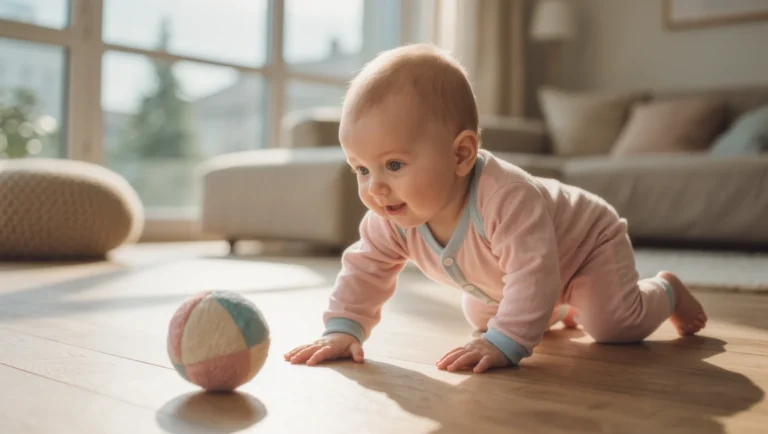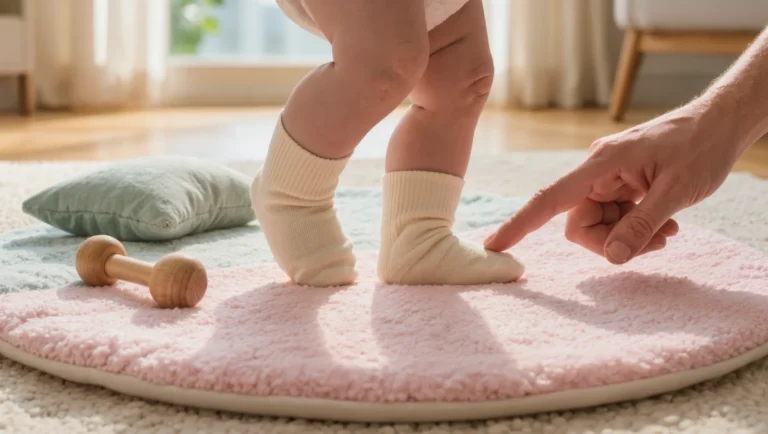


Most babies start pulling up to stand while holding on somewhere between 9 and 12 months, and stand completely on their own a little later. According to the WHO (World Health Organization), the window is wide: healthy babies stand alone anywhere from about 7 to 17 months. The calendar is a guide, not an exam.
It’s a classic scene: your baby grabs the edge of the sofa, hauls themselves up and gives you a look that says “Did you SEE that?!”. Ten seconds later the whimpering starts, because… they have no idea how to sit back down. 😅
If you’re wondering whether your baby “should” be standing by now, or your cousin’s little one of the same age is already lapping the coffee table – that worry is completely understandable. Relax, it’s all fine: when it comes to standing, babies differ hugely, and that’s perfectly normal.
You’ll get there together – one step at a time (literally).
When do babies pull up to stand?
Most babies pull themselves up to standing, holding onto furniture, between 9 and 12 months. According to an NHS (UK National Health Service) information leaflet, the average age is around 11 months. Some start earlier, others a little later – both are within the normal range.
Pulling up usually comes once a baby sits steadily and gets around in some way – crawling, commando-crawling on their tummy or bottom-shuffling. Any of these is fine (more in Crawling: when it happens and why some babies skip it).
The AAP (American Academy of Pediatrics) describes something you’ll recognise: once babies learn it, they pull up at every chance they get – but at first they often don’t know how to get back down.
When do babies stand alone without holding on?
Standing without support comes after pulling up and has a very wide range. In the WHO’s large motor development study, healthy babies stood alone somewhere between about 6.9 and 16.9 months. So a one-year-old who still holds onto the sofa is not “behind”.
Here’s how the milestones look side by side:
| Skill | NHS: average age (range) | WHO: window of achievement |
|---|---|---|
| Pulls to stand / stands with support | 11 months (9–12) | 4.8–11.4 months |
| Stands alone | – | 6.9–16.9 months |
| Walks alone | 14 months (10–18) | 8.2–17.6 months |
Why do the “with support” numbers differ? The WHO measures “standing with assistance” (the baby stands while holding on), while the NHS leaflet measures the pulling up itself. They’re related, but not the same thing.
Is it normal for a baby to stand holding on for a long time before walking?
Yes. The NHS notes that some children move quickly from standing to walking along furniture, while others take several months. Both rhythms are normal. Your baby is training balance, leg strength and courage – and that happens at different speeds.
Read alsoWhen do babies look for hidden toys? Object permanence & peekabooMontessori toys by age: how to choose
Some babies cruise around the furniture for quite a while and then suddenly set off. The AAP says most children go from their first wobbly steps to confident walking within days. For the next stage, see When do babies start walking and how can you help?.
How can I help my baby stand up?
What helps most is plenty of free floor play, sturdy things to hold onto and a bit of encouragement. You don’t need to “teach” your baby to stand – they’ll go looking for chances on their own. Your job is to make those chances safe.
- Lots of floor time. The NHS leaflet says the floor is the best place for babies to build strength and movement skills.
- Sturdy support. A low sofa or coffee table without sharp edges. The AAP advises that anything your baby uses for support should be properly weighted or attached so it can’t tip.
- Show them how to sit down. If your baby gets stuck standing and cries, the AAP suggests showing them how to bend their knees to lower themselves without falling.
- Push toys – sturdy ones only. If you use a push cart or wagon, it should have a bar to push and be weighted so it won’t tip when your baby pulls up on it.
- Skip the baby walker. The AAP strongly urges parents not to use baby walkers: they don’t help children learn to walk and carry a risk of falls (more in Myth or truth: “A baby walker helps your baby walk sooner”?).
Turn sitting down into a game: when your baby is standing, sit next to them and say a cheerful “and… squat!” while gently bending their knees. After a few rounds they’ll do it alone – saving you plenty of night-time rescue missions to the cot. 😉
Put a favourite toy on the low coffee table instead of the floor. Suddenly standing up makes sense: there’s a prize up there. 🎁
How should I prepare my home when my baby starts pulling up?
Once your baby starts pulling up, their world literally grows by half a metre. Look at your home from their height: what can they grab, what’s wobbly and what’s sitting on the edge of the table? A little preparation now saves a lot of “ouch” later.
- Furniture: secure cabinets and shelves they might pull up on.
- Stairs: the AAP advises sturdy gates at the top and bottom (Stair gates for babies: how to choose the right one (and when to remove it)).
- Small objects: clear coins, buttons and batteries from low places – the AAP flags them as especially dangerous.
- Shoes: not needed indoors for first attempts. The AAP advises shoes once a child starts walking outside – closed-toe, comfortable, flexible, with non-slip soles (Baby’s first shoes: when they need them and how to choose).
For dads
You make the perfect “human handrail”. Sit on the floor with your arms out and let your baby pull up on you. And while mum drinks her coffee hot (for once), crawl around the house on all fours and check what pulls, wobbles or falls. Sounds silly, works brilliantly.
When should I ask the paediatrician?
The NHS advises seeking advice if you’re concerned your child isn’t reaching some milestones. Talk to your paediatrician or health visitor if:
- around their first birthday your baby makes no attempt at all to pull up or take weight on their legs;
- something about the way they move simply worries you – your instinct counts as information too.
Your paediatrician knows your baby and will look at the whole picture, not just one date.
In short
Pulling up to stand usually arrives between 9 and 12 months, and standing alone somewhere between 7 and 17 months, with huge, normal differences. Offer floor time, sturdy support and lots of applause, and let your baby set the pace. You’re already their steadiest support. 💛
Sources: WHO – Motor development milestones (Windows of achievement, WHO Multicentre Growth Reference Study, Acta Paediatrica 2006); NHS Northern Care Alliance – Paediatrics: Normal Development; AAP / HealthyChildren.org – Movement: Babies 8 to 12 Months.