

Many babies start clapping and waving at around 9–10 months, and by their first birthday most wave goodbye and point with their index finger. These are guides, not deadlines: every baby has their own pace.
Your aunt is at the door, waving and singing “Bye-bye!” for the fifth time. Your baby stares back like a tax inspector. The door closes – and right then, they cheerfully wave at the wall. 😅
If you’re wondering whether yours is “behind”, that’s completely understandable. Relax, it’s all fine: gestures arrive in waves and often show up exactly when nobody is watching.
When do babies start clapping?
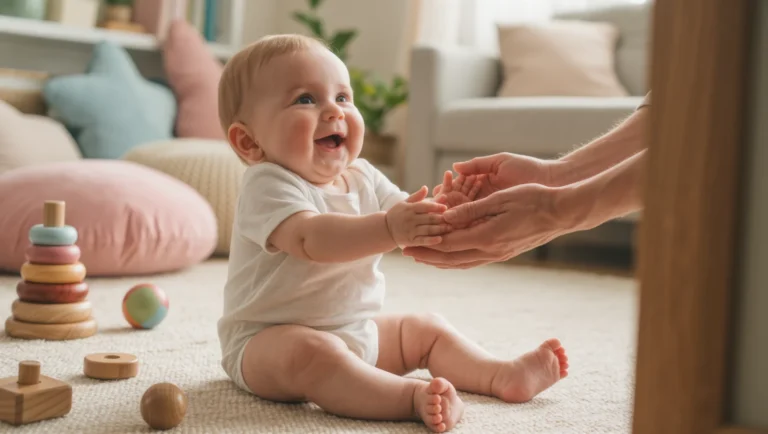
According to the Welsh Government’s child development guidance, at around 9–10 months many babies may be able to clap and wave. The first attempts are often a bit hit-and-miss: hands meet every other time, or the table gets the clapping instead. That still counts – your baby is copying you and practising coordination.
Babies love hand games. Queensland Health (Australia) suggests finger and toe rhymes, peekaboo and clapping hands for the 9–12 month stage – exactly the games where clapping is learned.
When do babies wave bye-bye?
Waving often appears together with clapping, at around 9–10 months, according to the Welsh guidance. And according to MedlinePlus (the health library of the US National Institutes of Health), the typical 12-month-old waves goodbye and points to objects with the index finger. Waving bye-bye to the right person at the right moment comes later than the movement itself.
The reason is simple: to wave bye-bye, your baby needs to understand that someone is leaving. The Welsh guidance notes that at around 9–10 months many babies understand words like “no” and “bye-bye”.
| Gesture | What it looks like | Guide from the sources |
|---|---|---|
| Clapping | Hands meet, sometimes hit-and-miss | Often around 9–10 months (Wales) |
| Waving | Opens and closes the hand or waves the whole arm | Often around 9–10 months (Wales) |
| Bye-bye wave | Waves when someone leaves | Typical by 12 months (MedlinePlus) |
| Pointing | Index finger points at something interesting | May start around 9–10 months, typical by 12 months (Wales, MedlinePlus) |
| Raising arms when dressing | “Helps” with sleeves | Typical around 12 months (MedlinePlus) |
Why do gestures matter for speech?
Gestures are words without sound. When your baby points at the dog or waves bye-bye, they’re already talking to you – saying “look!” and “goodbye” before they can say them out loud. That’s why it helps to respond: every gesture is a line in a conversation.
Read alsoWhen do babies respond to their name? Calm, clear milestonesCrawling: when it happens and why some babies skip it
The Welsh guidance suggests that when your baby points, you say what they see – “Yes, that’s a dog.” Queensland Health adds that the more you talk to your child and respond to their attempts to communicate, the easier it is for their language to develop. More on the road to first words in First words: how speech develops.
How can you encourage gestures at home?
The best teacher isn’t a toy – it’s you. Babies learn through routine and repetition, so short games every day do more than one big lesson.
- Show it slowly, with a smile: clap while you sing a favourite song.
- Wave bye-bye every time: to grandma, the bus, the cat, the bath water going down the drain.
- Name things: when your baby points, say the word out loud.
- Play peekaboo and finger rhymes: they suit the 9–12 month stage.
- Wait for a reply: pause after your gesture so your baby has time to copy.
- Celebrate the attempt: even “half” a clap deserves applause.
Turn goodbyes into a ritual: every morning wave bye-bye to the window, the car and the teddy in the cot. After a week or two, many babies start lifting a hand on their own as soon as they hear “bye-bye”. 👋
Is it normal if my baby isn’t waving at one year?
Yes, it’s often normal. MedlinePlus reminds us that all children develop a little differently. Some babies point first, some clap first, and some save waving “for special guests”. Look at the bigger picture: does your baby look for your eyes, respond to their name and try to communicate in their own way?
If your baby is busy crawling or taking first steps, gestures sometimes wait a little – the energy is going elsewhere. For the bigger picture, see Baby development month by month: 0–12 months at a glance and the Development & Play category.
Don’t “test” your baby in front of guests (“Come on, wave to Uncle!”). Under pressure most babies freeze. Playing at home, without an audience, works much better. 😊
For dads
You’re the perfect clapping partner. Put on a song, sit on the floor facing your baby and clap together. And in the morning, before you leave, wave bye-bye from the door – then wait a second. You might be the one who sees the first real bye-bye.
When should you talk to your doctor?
Mention it to your doctor or health visitor if, around the first birthday, your baby uses no gestures at all (no pointing, waving or showing what they want), rarely responds to their name, or seems to be losing skills they had before. As MedlinePlus and Queensland Health advise: if you’re concerned about your child’s development, talk to your doctor or child health nurse. They know your baby and will look at things calmly.
In short
Clapping, waving and pointing usually appear between 9 and 12 months, each in its own time. Gestures are your baby’s first words – and you’re already their most appreciative audience. Keep singing, waving and cheering: you’re doing brilliantly. 💛
Sources: MedlinePlus (U.S. National Library of Medicine) – Normal growth and development: 12 months; Welsh Government – Parenting. Give it time: your baby 7–12 months; Queensland Health – How your baby develops: 9–12 months.