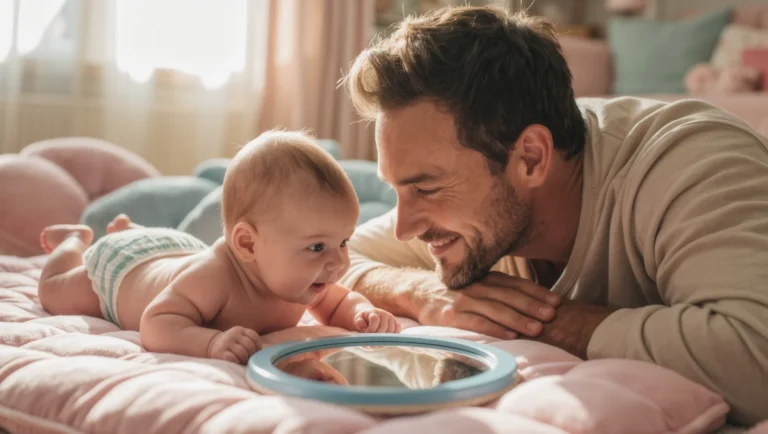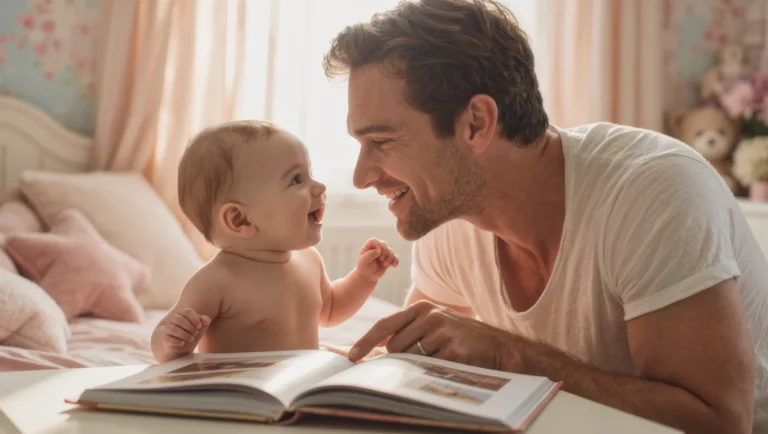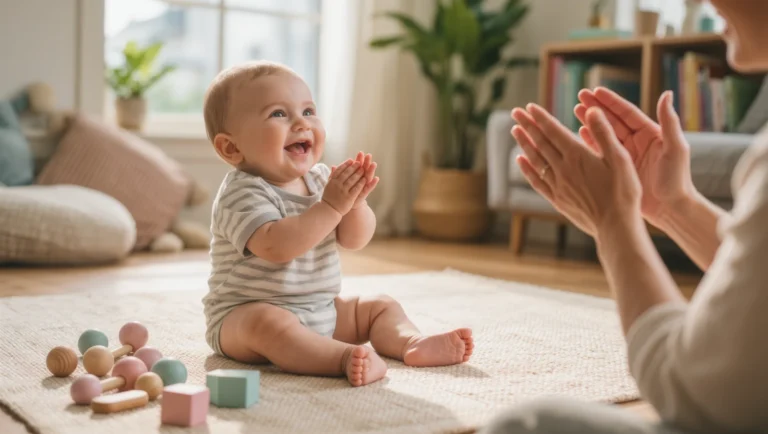


A newborn sees blurry images and focuses best at about 20–30 cm (8–12 inches) – right about the distance to your face during a feed. Vision improves fast: around 3 months babies follow moving objects, around 5 months depth perception kicks in, and by about 8 months they see almost like an adult.
You’re gazing into their eyes, pulling your very best funny faces, and they’re… staring somewhere over your shoulder. At the lamp. Or the edge of the curtain. 😅
If you’re wondering “can they even see me?” – that’s a completely fair question. Don’t worry, all is well: babies aren’t born with finished eyesight. They learn to see, just like they learn to grab and sit. And you’re already helping, simply by being close.
What can a newborn see?
A newborn sees light, shapes, faces and movement, but anything far away is a blur. According to the AAP (American Academy of Pediatrics), newborns see best at about 20–30 cm away. That’s roughly the distance from their eyes to yours when you feed or hold them.
According to SickKids (the Toronto children’s hospital), within the first hours after birth babies can tell their parent’s face from someone else’s. Newborns love:
- Eyes and faces: especially mum’s and dad’s.
- Strong contrast: black and white, sharp outlines, dots and checkerboards.
- Movement: a slowly moving object catches their gaze.
Little surprise: pastel toys are a bit boring for the very youngest. Soft colours are harder for them to make out. Pastels are really for us parents. 😊
How does a baby’s vision develop month by month?
Vision develops step by step across the whole first year. First comes close-up focus, then tracking movement, then colours and depth, and finally a clear picture at a distance. The ages below are guideposts from SickKids, the AAP and the AOA (American Optometric Association), not an exam – every baby moves at their own pace.
| Age | What babies usually can do |
|---|---|
| Newborn | Sees most clearly at 20–30 cm, loves faces and contrast |
| Around 1 month | Sees about 1 metre from their face |
| Around 2 months | Eyes work together better, makes eye contact, tracks movement |
| Around 3 months | Focuses on faces and nearby objects, follows a moving toy, studies their own hands |
| Around 4 months | Tells colours apart better, reaches for and grasps objects |
| Around 5–7 months | Starts seeing in depth, follows a toy that falls or rolls away |
| Around 8 months | Near-normal vision, notices things across the room |
According to the AAP, children only see as well as adults at around 3 to 5 years old. So the first year is just the big kick-off.
Read alsoGames to play with a newborn (0–3 months)Baby development month by month: 0–12 months at a glance
Is it normal for a baby’s eyes to cross?
Yes. In the first weeks it’s normal for a baby’s eyes to sometimes wander, cross or move independently, because they’re still learning to use both eyes together. According to the AAP, this should settle by 2 to 3 months. If an eye turns all the time, or after 3 months, mention it to your paediatrician.
The NHS (the UK’s health service) also advises not to ignore a squint that is there all the time or appears after 3 months of age. The earlier it’s checked, the better.
Not sure whether an eye is “drifting”? Take a photo in daylight while your baby looks straight at you. It’s a great help for the paediatrician – and for you, instead of peering at it 40 times a day. 📸
When do babies start to see colour?
Babies see some colours in the first weeks, but colour vision develops gradually. According to the AAP, at around 4 months babies are much better at telling colours and shades apart. The AOA says babies are generally believed to have good colour vision by 5 months, though not yet as sensitive as an adult’s.
SickKids notes that young babies are drawn to bright primary colours – red, blue and yellow. That’s why bold books and toys often win over pastel ones.
How can I help my baby’s vision develop?
You don’t need special gadgets. Vision develops best in an ordinary day: your face up close, chatting, moving around the room and floor play. The AOA suggests simple age-appropriate activities, and here they are in an order that fits easily into your day:
- Stay close: talk to your baby from 20–30 cm away. You’re the most interesting picture in the room.
- Switch sides: alternate left and right sides with each feed, so they look in different directions.
- Move and talk: walk around the room while chatting, so they follow you with their eyes.
- Toys at the right distance: up to about 4 months, keep look-and-touch toys at 20–30 cm.
- Floor time: from around 5 months, give plenty of time to play and explore on the floor – including Tummy time: why it matters and how to make it fun.
- Peekaboo: around 9–12 months, play hide-and-seek with your face or a toy. It builds visual memory.
Make a “newborn card”: black marker, white card, thick stripes and dots. Cheap, quick, and for the first weeks more fascinating than any pricey toy. 🎁
Seeing goes hand in hand with grasping – see also When do babies start grabbing toys? From fist to pincer grasp. And you’ll find more play ideas by age in Development & Play.
For dads
Your face is one of your baby’s favourite “pictures”. Beard, glasses, eyebrows – it’s all interesting contrast. Hold your baby, come in to about a hand-span away, talk slowly and let them study you. Two minutes a day and you’ve got your own little ritual.
When should I talk to the paediatrician?
Most babies develop their vision without any trouble – according to the AOA, problems at this age are rare. Still, mention it to your paediatrician if you notice:
- An eye that turns all the time or a squint after 3 months of age.
- Your baby doesn’t follow faces and objects at around 3 months.
- Lots of tearing or red, crusty eyelids.
- Strong sensitivity to light.
- A white spot in the pupil (sometimes visible in a flash photo) – see a doctor about this without delay.
Your paediatrician knows your baby and can refer you to a children’s eye doctor if needed.
In short
Your baby is born with a blurry picture and brings it into focus month by month. By around 8 months they see almost like you – and their favourite view the whole time stays the same: your face. Keep staying close – you’re already doing exactly what they need. 💛
Sources: AAP / HealthyChildren.org – Infant Vision Development: What Can Babies See?; SickKids / AboutKidsHealth – Vision in the first year; American Optometric Association – Infant Vision: Birth to 24 Months of Age; NHS – Squint.