

Most babies don’t sleep through the night in the first months, and that’s normal. According to the NHS (the UK’s national health service), some babies aged 3 to 6 months sleep 5–8 hours at night, and around 6 months some manage up to 12 hours. Many others still wake up after their first birthday.
The playground, 10 a.m. Another mum tells you her baby has “slept 8 to 8 since month two”. You smile and nod, while silently counting how many times you got up last night. Four? Five? Somewhere after the third coffee you stopped counting. 😅
If you feel tired and a little confused, that’s completely understandable. Night waking doesn’t mean you’re doing anything wrong. It’s part of how babies grow.
Don’t worry, all is well. Let’s look at what the facts say and how to win back a bit more sleep.
What does “sleeping through the night” actually mean?
For babies, “sleeping through the night” usually doesn’t mean 12 silent hours. In research it means 6 or 8 hours of uninterrupted sleep. A short waking, after which the baby drifts back off on their own, is perfectly normal – adults wake at night too, we just don’t remember it.
So the two mums at the playground may be talking about very different things. For one, “all night” is 11 p.m. to 5 a.m.; for the other, 7 p.m. to 7 a.m. 🌿
When do babies start sleeping through the night?
There’s no exact age. Newborns are very unlikely to sleep through, because their tummies are tiny and they need feeding. As they grow, night feeds drop and sleep stretches get longer, but every baby has their own rhythm. The NHS guide looks like this:
| Age | What the NHS says |
|---|---|
| Newborn | Very unlikely to sleep through – they need to feed. |
| 3–6 months | Fewer night feeds are needed. Some babies sleep 5–8 hours or more at night, but not all. |
| 6–12 months | Some babies no longer need night feeds and may sleep up to 12 hours at night. Teething and hunger can wake them. |
| After 12 months | Around 12–15 hours of sleep in total per 24 hours, including naps. |
The AAP (American Academy of Pediatrics) adds that babies don’t have regular sleep cycles until about 4 months of age. That’s why the early months feel so unpredictable. For total sleep by age, see also How Much Do Babies Sleep, Month by Month: Stress-Free Guidelines.
Is it normal for a 6-month-old to still wake at night?
Yes, completely normal. According to the AAP, it’s common for a 6-month-old to wake during the night and fall back asleep after a few minutes. And in a Canadian study published in the journal Pediatrics (Pennestri and colleagues, 2018), between 27.9% and 57.0% of 6- and 12-month-old babies did not “sleep through the night”, depending on whether 6 or 8 hours was counted.
Read alsoBaby Not Sleeping at Night: Honest Reasons and What to TryWhen can a baby sleep with a pillow and blanket? A calm guide
The best part of the same study: no link was found between sleeping through the night and a baby’s mental or motor development. The authors write that expectations of early uninterrupted sleep could be moderated. In other words, your baby isn’t behind – they just have their own pace.
And you’re not alone: a survey by The Lullaby Trust (a UK safer-sleep charity), quoted by the NHS, found that 59% of parents of babies under 12 months say their baby sleeps for less than 4 hours at a time. 💛
How can you help your baby sleep longer at night?
There’s no “all-night” button, but you can gently help your baby learn that day and night are different. The NHS and AAP share a few simple ideas you can follow step by step:
- Day is day: open the curtains, play, chat. Don’t keep the house silent during naps.
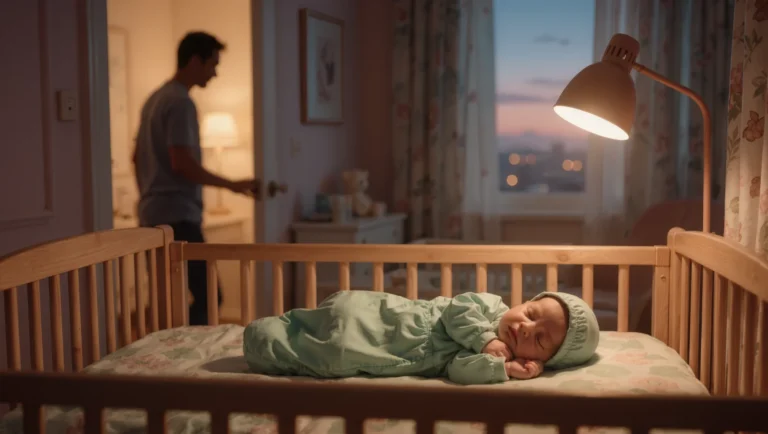
- Night is night: low lights, a quiet voice, no play during night feeds or nappy changes.
- Change the nappy only when needed at night, so you don’t wake your baby fully.
- A calm bedtime routine: bath, pyjamas, a story, a lullaby – in a similar order each evening. Ideas in Bedtime Routine: How to Create One.
- From around 4 months: the AAP suggests putting your baby down drowsy but still awake, so they learn to fall asleep on their own.
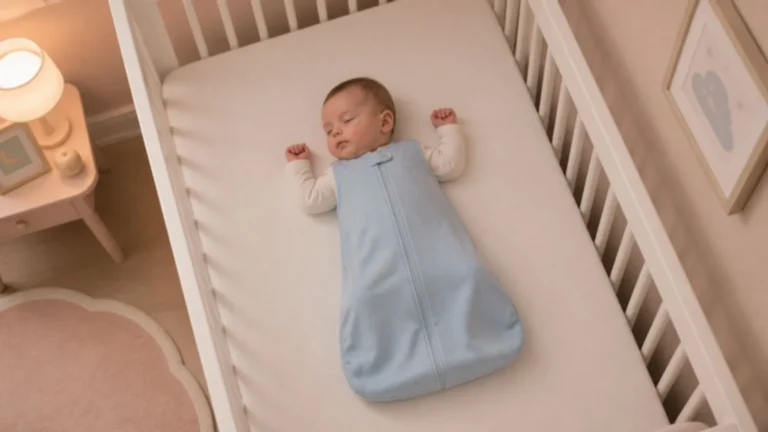
- Safe sleep, always: on their back, in their own cot, in your room for at least the first 6 months, according to the NHS. More in Safe Sleep: Simple Rules That Lower the Risk of SIDS.
Before you leap up at the first little grunt, wait a few seconds and listen. Sometimes your baby is just “talking in their sleep” and drifts back off. If they’re crying or hungry, of course go to them. Those few seconds aren’t indifference – they’re a chance for your baby to try on their own. 😊
Use a dim, warm night light instead of switching on the big light. You’ll see enough to feed, and your baby’s brain gets the message that it’s still night.
Remember too that sleep changes: according to the NHS, growth spurts, teething and illness can temporarily upset even the best rhythm. If nights suddenly get worse, it’s rarely a “step back”. More on common causes in Baby Not Sleeping at Night: Honest Reasons and What to Try and in the Baby Sleep category.
For dads
Nights are easier in shifts. If your baby has formula, take some of the night bottles. If they’re breastfed, take over the early-morning nappy change and dressing so mum can sleep a little longer – exactly what the NHS suggests. One hour of unbroken sleep can be worth more than any gift.
When should you ask your paediatrician?
Night waking on its own usually isn’t a cause for concern. Talk to your paediatrician or health visitor if:
- sleep changes suddenly and your baby seems unwell, unusually irritable or refuses feeds;
- you’re worried about weight gain or whether your baby is feeding enough;
- you’re so exhausted you’re struggling to cope – that’s a good reason to ask for support too.
Your paediatrician knows your baby and can judge what’s normal for them.
In short
“All night” arrives at a different time for every baby – for some around 6 months, for many others later – and it says nothing bad about their development. Help with a clear day–night difference, a calm routine and safe sleep. The nights will get longer, and you’re already doing better than you think. 💛
Sources: NHS – Helping your baby to sleep; NHS Best Start in Life – Your baby's sleep patterns; AAP / HealthyChildren.org – Getting Your Baby to Sleep; Pennestri MH et al. Uninterrupted Infant Sleep, Development, and Maternal Mood. Pediatrics, 2018.