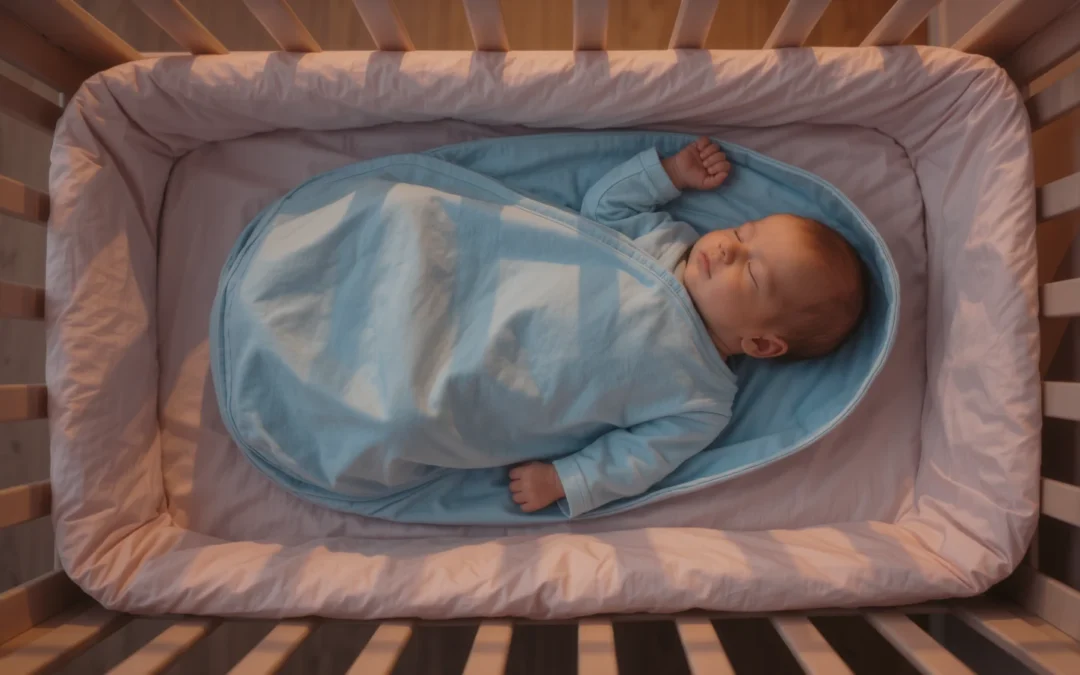
It’s 3 a.m. Your baby is awake, so are you, and your phone is showing an article saying “babies sleep 16 hours a day”. Yours clearly hasn’t read it. 😅
If you’re so tired that yesterday you poured coffee into the water glass – that’s normal. Sleep deprivation in the first months is real and hard, and it doesn’t mean you’re getting something wrong. Let’s look at what the numbers actually say – and how wide they are.
The short answer: Newborns sleep anywhere from about 8 to 18 hours in 24 hours. At 4–12 months the recommendation is 12–16 hours and at 1–2 years 11–14 hours, naps included. Plenty of babies at 6 and 12 months still don’t sleep 6–8 hours in a row, and in one study that wasn’t linked to slower development.
Why isn’t there one “right” number?
A baby’s sleep changes fast and is very individual. A large review of 34 studies (Galland and colleagues, 2012) shows that on average babies sleep about 12.8 hours in 24 hours, but the normal range is wide – roughly from 10 to 16 hours.
So think of the numbers below as a guide, not an exam.
How much does a baby sleep by age?
- 0–3 months: according to the NHS (the UK’s health service), some newborns sleep about 8 hours in total in 24 hours, others up to about 18. Both are normal. Sleep comes in short chunks, and day and night aren’t told apart yet.
- 4–12 months: 12–16 hours in 24 hours, including daytime naps. This is the recommendation of the American Academy of Sleep Medicine (AASM), endorsed by the American Academy of Pediatrics (AAP).
- 1–2 years: 11–14 hours in 24 hours, including naps (AASM).
Interestingly, the AASM gives no recommendation at all for babies under 4 months – precisely because the differences between individual babies are too big.
Don’t count the minutes – watch your baby. If they’re fairly settled when awake, feeding well and gaining weight, they’re most likely getting the sleep they need. The number in the app is only a helper.
When do babies start sleeping longer at night?
There’s good news here. In a study following 75 babies through their first year (Henderson and colleagues, Pediatrics, 2010), the biggest jump towards longer night sleep came between 1 and 4 months.
And another reassuring finding: a Canadian study of nearly 400 babies (Pennestri and colleagues, 2018) shows that between 28% and 57% of babies at 6 and 12 months still don’t sleep 6–8 hours in a row. And this isn’t linked to slower development.
In other words, if your baby still wakes up – they’re in very good company.
What to watch instead of the clock
- Tired signs: rubbing eyes, yawning, staring into space, grizzling. Put them down to sleep before they get overtired.
- Rhythm: over time, sleep sorts itself out – more at night, less during the day.
- Safety: for every sleep – on their back, on a firm, flat mattress, with no pillows or soft toys. If you swaddle, see how to do it in a hip-safe way.
If you’re wondering whether your baby is sleeping enough, keep a short diary for 3–4 days: when they fall asleep and when they wake up. You’ll see the bigger picture – and you’ll have real data if you decide to ask your paediatrician.
For the dads
Nights are easier to survive in shifts. If your baby is bottle-fed or has expressed milk, one of the night shifts can be yours. If they’re breastfed – take over the nappy changes, the burping and settling them back in the cot. Small for you, huge for an exhausted mum.
When to ask your paediatrician
Mention it at your check-up if your baby is unusually sleepy and hard to wake for feeds, sleeps a lot less than usual and is constantly irritable, or if something about their breathing during sleep worries you. Your paediatrician knows your baby and is best placed to judge.
In short
The numbers are a map, not a satnav shouting “recalculating” at every detour. Your baby has their own rhythm, and you’re getting to know it bit by bit. It gets easier day by day – and you’re already doing better than you think. 💛
Sources: HealthyChildren.org (AAP) – Healthy Sleep Habits: How Many Hours Does Your Child Need?; NHS – Your baby’s sleep patterns; Sleep Medicine Reviews (Galland et al., 2012) – Normal sleep patterns in infants and children; McGill University – Pennestri et al., Pediatrics 2018.
More from this section


Your baby, week by week
Once a week: what's coming up, one useful tip and nothing extra.