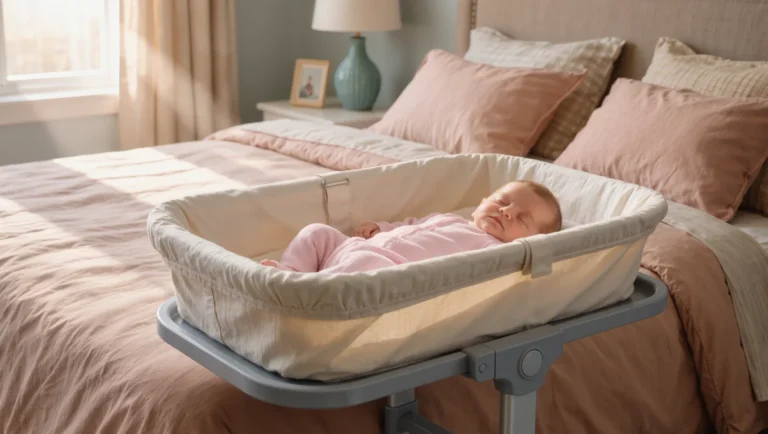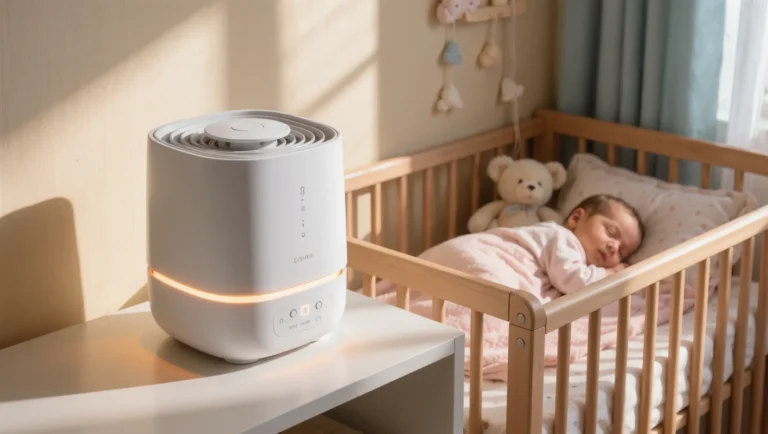


According to the NHS (the UK’s health service) and the AAP (American Academy of Pediatrics), your baby should sleep in your room – in their own cot or Moses basket – for at least the first 6 months, for naps and at night. After that, exactly when they move to their own room is a family decision.
The nursery has been ready for months. Soft walls, a perfectly made cot, a mobile waiting to spin. And the baby? Sleeping half a metre away, snuffling like a tiny hedgehog every time you turn over. 😅
If you’re wondering “is it time yet?” while also feeling a pang just thinking about it – that’s completely understandable. Both feelings are normal. Don’t worry: there’s no wrong date on the calendar, just some helpful guideposts.
When can a baby sleep in their own room?
The NHS advises putting your baby in a separate cot or Moses basket in the same room as you for at least the first 6 months, for every sleep – day and night. The AAP recommends the same: at least the first 6 months in the parents’ room, close to your bed but not in it. After 6 months, the move depends on your family’s readiness.
| Source | What it recommends | Detail |
|---|---|---|
| NHS (UK) | At least the first 6 months in your room | For every sleep – naps included |
| AAP (US) | At least the first 6 months in your room | Close to your bed, but never in the same bed |
“At least” is the key phrase. Six months isn’t an eviction notice. Some families move their baby soon after 6 months, others much later. Both are fine.
Why should a baby sleep in your room for the first 6 months?
It’s about safer sleep. According to the NHS, sudden infant death syndrome (SIDS – the rare, unexplained death of an apparently healthy baby during sleep) is more likely in the first 6 months. The AAP says room sharing can lower the risk of SIDS by as much as 50% and is much safer than sharing a bed.
There’s a practical upside too: the AAP notes that having your baby nearby makes it easier to feed, comfort and keep an eye on them at night. You’ll find the basics in our guide Safe Sleep: Simple Rules That Lower the Risk of SIDS.
Read alsoBaby room temperature in winter: how warm and how to dress baby for sleepWhen can a baby sleep with a pillow and blanket? A calm guide
“Same room” doesn’t mean “same bed”. The cot can sit right next to your bed, but your baby sleeps on their own firm, flat mattress, on their back, with no pillows or covers around them. Close – yes. In your bed – better not.
How do you move a baby into their own room?
The easiest transition is gradual and predictable. Get the room ready, keep the familiar bedtime routine and start at a calm time at home – no trips, visitors or other big changes. Babies love the familiar, and you love sleep. 😊
- Set up the cot: firm, flat mattress, empty cot – no pillows, bumpers, soft toys or loose blankets.
- Check the temperature: the NHS suggests keeping the room at about 16 to 20°C. More on winter nights in Baby room temperature in winter: how warm and how to dress baby for sleep.
- Start with naps: a few daytime sleeps in the new room help your baby get to know it in daylight.
- Keep the routine: bath, pyjamas, story, dim lights – the same order every evening. Ideas in Bedtime Routine: How to Create One.
- Set up the baby monitor: you’ll hear your baby without leaping up at every rustle. How to choose one: Baby Monitor: How to Choose – Audio, Video or WiFi.
- Give it a few nights: the first evenings may be a bit unsettled. That’s normal and usually passes.
Do you have to move your baby at exactly 6 months?
No. Both the NHS and the AAP say “at least” 6 months, not an exact date. If you and your baby are sleeping well in the same room, there’s no rush. If you keep waking each other up with every snuffle, after 6 months a separate room might bring more sleep for both of you.
Listen to your own family: how much space you have, how your baby sleeps, how you sleep. Don’t panic if a friend moved theirs earlier or later. Your rhythm is yours.
Use a cot sheet you’ve kept close to you for a little while – a familiar smell can be a small comfort in a new room. Just fit it tightly over the mattress, with no wrinkles and no extra blankets. 🌿
For dads
The move is the perfect moment to take on the “evening shift”. Build the cot, check the room thermometer, set up the monitor and lead the bedtime routine a few nights a week. Your calm voice will become part of the new room.
When should you ask your pediatrician?
If your baby was born early (before 37 weeks), the NHS advises following safer sleep advice for a year from their due date rather than their birth date – talk to your pediatrician about when a move makes sense. Ask too if your baby has a health condition, if sleep suddenly gets much worse, or if anything worries you. Your pediatrician knows your baby and will help you decide calmly.
In short
For at least the first 6 months, your baby sleeps in your room, in their own cot – after that, you decide when you’re ready. The nursery isn’t going anywhere, and your little hedgehog will adjust. You already know more than you think. 💛
More ideas for calmer nights in our Baby Sleep section.
Sources: NHS – Sudden infant death syndrome (SIDS); NHS – Helping your baby to sleep; AAP / HealthyChildren.org – How to Keep Your Sleeping Baby Safe: AAP Policy Explained.