
This guide may contain affiliate links. If you buy through them, we may earn a small commission at no extra cost to you. Learn more
Three in the morning, the third feed of the night. The cot seems miles away, and your own bed so very close. Lots of parents have been exactly there, with the kind of tiredness words can’t describe.
Co-sleeping stirs up strong opinions. We’re not going to try to convince you of anything here. We’ll show you what different reputable sources say – and the decision stays with your family, together with your paediatrician.
The short answer: Sharing a room but not a bed is what the AAP recommends, ideally for at least the first 6 months. It doesn’t recommend bed-sharing, especially with a baby under 4 months, after alcohol or sedating medicines, with smoking or on soft bedding. UK guidance also advises on safer bed-sharing, because many parents fall asleep with their baby unplanned.
What exactly are we talking about?
“Co-sleeping” is used for two different things:
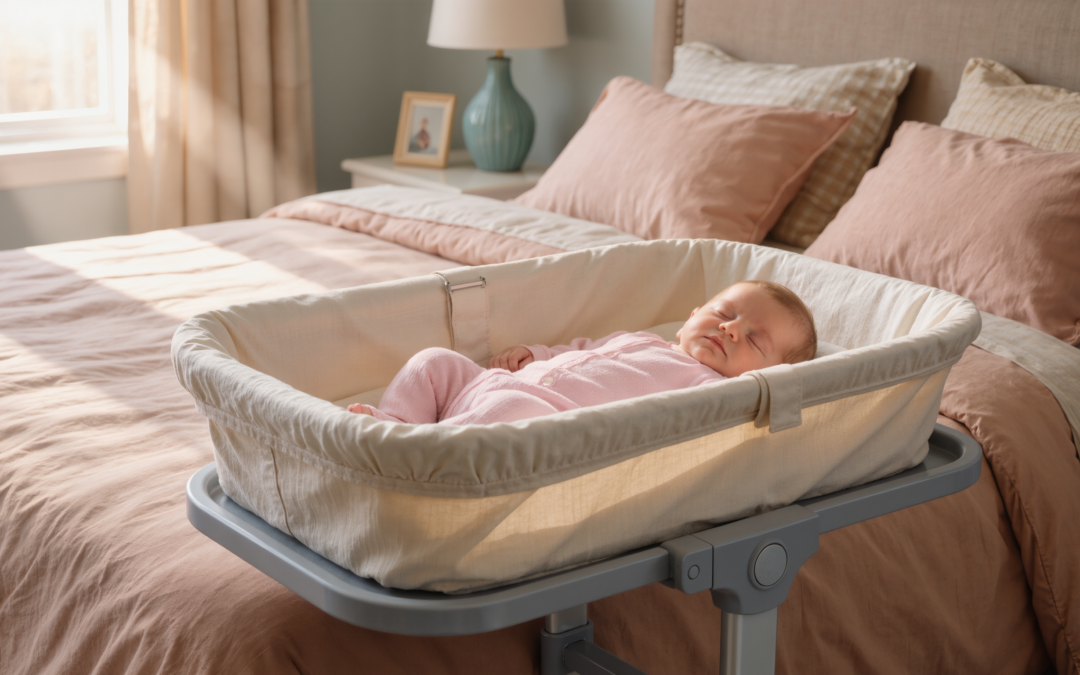
- Room-sharing – your baby sleeps in their parents’ room, but in their own cot or Moses basket.
- Bed-sharing – your baby sleeps in the same bed as an adult.
Room-sharing isn’t controversial: almost all major organisations recommend it. The differences are about bed-sharing.
What does the American Academy of Pediatrics say?
In its 2022 recommendations, the AAP advises that babies sleep in their parents’ room but on a separate surface – ideally for at least the first 6 months. The Academy doesn’t recommend bed-sharing, because research links it to a higher risk of sleep-related incidents. It also lists situations where the risk is especially high: a baby under 4 months, a parent under the influence of alcohol or sedating medicines, smoking, soft bedding and pillows.
What do UK sources say?
In the UK, the approach differs in form but not in aim. The national institute NICE (which produces medical guidelines) recommends that health professionals talk to parents about safer bed-sharing practices and about situations where it should be avoided. The Lullaby Trust also offers advice on safer co-sleeping – arguing that many parents end up falling asleep with their baby even without planning to.
The Academy of Breastfeeding Medicine (ABM), in its 2019 protocol, looks at bed-sharing among breastfeeding mothers, describes the dangerous circumstances and the elements of safer practice. It stresses itself that these are guidelines, not a standard for everyone.
Even if you’re not planning to bed-share, set up your bedroom as if it might happen: no extra pillows around the feeding spot and no gaps by the wall. Lots of tired parents doze off without meaning to.
Where do all sources agree?
There are situations where there’s no disagreement at all – not between the AAP, the UK sources or the ABM. Bed-sharing is considered dangerous if:
- the sleep happens on a sofa or armchair;
- someone in the bed has drunk alcohol, taken medicines that make sleep deeper, or drugs;
- someone in the bed smokes;
- the baby was born prematurely or with a low birth weight;
- there is soft bedding or pillows around the baby, or the baby sleeps on their tummy.
If you do sleep together: what does the Lullaby Trust recommend?
This is risk-reduction information, not a recommendation to bed-share:
- your baby is on their back, on a firm, flat mattress;
- there are no pillows or duvets around them;
- there are no other children or pets in the bed;
- your baby isn’t swaddled and isn’t overdressed.
Talk the topic through with your paediatrician in the first weeks – honestly and without embarrassment. They know your baby and can judge whether any of the risk factors apply to you.
Is there a middle way?
Many families choose a bedside crib or cot attached snugly to the parents’ bed. The AAP notes that such products need to meet safety standards to count as a safe sleep space. If you’re thinking of swaddling as part of your night routine, see how to swaddle safely – and remember that a swaddled baby only sleeps on their own surface.
For the dads
The decision about night-time sleep is a shared one. If you’ve recently had a glass of wine or taken medicine that makes you drowsy, say so calmly. That’s important information, not a confession.
In short
There’s no single answer that fits every family, which is why this article doesn’t hand you a verdict. It gives you the facts. With them, with your paediatrician and with what you know about your own child, you’re the best-prepared person to make the choice – and to make it safely. 🤍
Sources: AAP, Pediatrics 2022 – Sleep-Related Infant Deaths: Updated 2022 Recommendations; NICE – Postnatal care, Quality statement 5: Safer practices for bed sharing; The Lullaby Trust (NHS leaflet) – Safer sleep advice: co-sleeping; Breastfeeding Medicine – Bedsharing and Breastfeeding: ABM Protocol #6, Revision 2019.
More from this section


Your baby, week by week
Once a week: what's coming up, one useful tip and nothing extra.
