

Most babies give their first chuckle at around 4 months, usually when you’re trying to make them laugh. According to the AAP (American Academy of Pediatrics), at this age it’s more of a chuckle than a full laugh. A proper belly laugh usually develops between 4 and 6 months.
You’re pulling faces, singing in your silliest voice, blowing raspberries on their tummy… and your baby is staring back like a very serious exam board. 😅 Meanwhile, your cousin swears hers was giggling at three months.
Relax, everything is fine. Laughing isn’t a race, and every baby has their own rhythm. The good news: every time you chat face to face, you’re both already practising for it.
When do babies first laugh out loud?
The first chuckle usually arrives at around 4 months. According to the AAP, at this age a baby “chuckles (not yet a full laugh) when you try to make them laugh.” A study by Mireault and colleagues (2018) in the British Journal of Developmental Psychology also describes babies laughing by 4 months.
The smile comes first. At around 2 months, again according to the AAP, babies smile when you talk to them or smile at them. For more on that stage, see when babies start smiling.
| Age (rough guide) | What you might notice |
|---|---|
| around 2 months | Smiles when you talk to or smile at them (AAP) |
| around 4 months | Chuckles when you try to make them laugh; laughs mostly at you (AAP, Mireault and colleagues) |
| around 5 months | Can laugh at something absurd even when you keep a straight face (Mireault and colleagues) |
| 4–7 months | Enjoys social play, often seems joyful, uses their voice to show joy (AAP) |
What do babies laugh at?
At first, your baby laughs mostly at you: your voice, your face and your reactions. Research by Mireault and colleagues with more than 100 babies found that 4-month-olds laugh in response to social cues, while 5-month-olds can spot the absurd on their own and laugh even if the parent stays serious.
In other words, at around 5 months babies start to notice when something is “out of place”. A sock on Dad’s nose? Comedy gold. 🧦 It’s a small but meaningful step: laughter shows your baby is noticing what’s usual and what’s a surprise.
Read alsoWhen do babies start smiling? Your baby’s first real smileFirst words: how speech develops
How can I make my baby laugh?
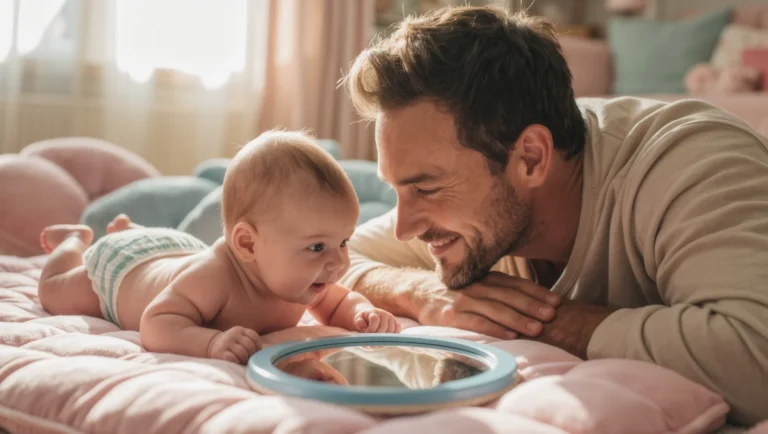
Your baby’s favourite comedian is you. Get close, face to face, when your baby is fed, rested and calm. Use your voice, your expressions and simple surprises. If your baby turns away or starts crying, take a break: it’s a sign they’ve had enough for now.
- Pick your moment: after a nap and a feed, when your baby is awake and curious.
- Talk and sing cheerfully: the NHS (the UK’s health service) suggests talking and singing cheerfully to your baby while holding them from 4 months.
- Play peekaboo: hide your face behind your hands and “reappear” with a smile. More on this game in when babies look for hidden toys.
- Add a little absurdity: a hat on the teddy’s head, a funny noise, a “disappearing” spoon.
- Repeat: babies love the same joke many, many times. You’ll get tired before they do. 😊
Don’t chase the laugh, chase the connection. Sometimes the funniest thing for a baby is simply you copying their sounds. They say “aaah”, you say “aaah” – and suddenly you’re in a conversation that may end in giggles.
Is it normal if my baby isn’t laughing yet?
Yes, in most cases it’s normal. The AAP stresses that every baby develops in their own way and it’s impossible to say exactly when they’ll master a given skill. Some babies are serious observers: they watch, listen and think before they “give away” their laugh.
Laughter is just one piece of the picture. Smiles, cooing, looking at you and interest in people say just as much. For the bigger picture, see baby development month by month or browse more in Development & Play.
Film that first giggle if you can. Just don’t be surprised if your baby goes quiet the second you pull out your phone. Babies have a great sense of drama. 🎬
For dads
Silly voices, funny faces and peekaboo can be your stage. Set aside a few minutes every day face to face with your baby, phone away. Those minutes are small, but they do a lot for your bond.
When should I ask the pediatrician?
According to the AAP, it’s worth mentioning to your pediatrician if your baby isn’t laughing or making squealing sounds by 6 months, isn’t smiling spontaneously by 5 months, or shows no interest in games like peekaboo by 8 months. Mention it too if something simply worries you – no question is too small.
Your pediatrician knows your baby and will look at the whole picture, not just one skill.
In short
The first chuckle arrives at around 4 months, and a real laugh usually develops by 6 months. Laughter is like spring sunshine: it arrives gradually, not on a timetable. Keep talking, singing and pulling silly faces – your audience already adores you. 💛
Sources: AAP / HealthyChildren.org – Developmental Milestones: 1-4 Months Old; AAP / HealthyChildren.org – Developmental Milestones: 7 Months; Mireault G. C. et al. (2018). Social, cognitive, and physiological aspects of humour perception from 4 to 8 months. British Journal of Developmental Psychology, 36, 98–109; NHS – Baby and toddler play ideas.