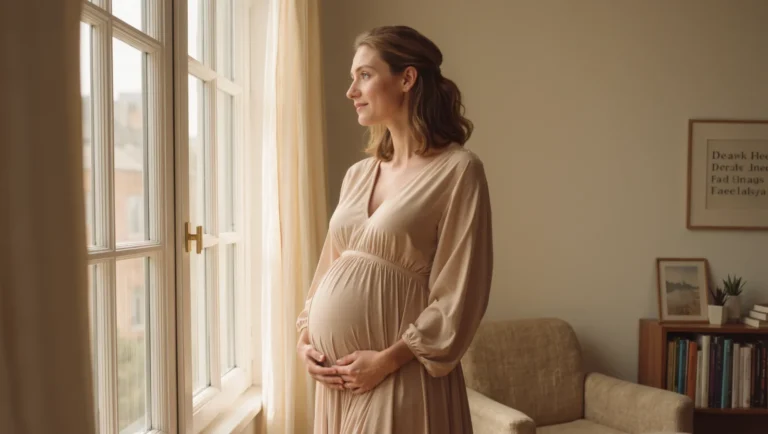


Most mums-to-be feel their baby move for the first time between 16 and 24 weeks of pregnancy. In a first pregnancy it’s perfectly normal for this to happen after 20 weeks, and if you’ve had a baby before, it’s often a little earlier. 🌿
You’re lying on the sofa one evening and suddenly – something. Like a tiny bubble popping. Or a little fish doing a turn. You freeze, hold your breath and wait for it again. Nothing. “Was that the baby, or was that dinner?” 😅
If you’re wondering, fretting or checking the calendar every day – that’s completely understandable. Relax, all is well: first movements arrive at a different time for every woman and every pregnancy.
When do you first feel your baby move?
According to the NHS (the UK’s health service), first movements are felt between 16 and 24 weeks of pregnancy. If this is your first baby, you might not feel them until after 20 weeks. In a large study of 2,009 pregnant women, the average point of first feeling movement was around 19 weeks.
Here’s the fun part: your baby starts moving much earlier. According to Cleveland Clinic (a major US medical centre), the little one begins moving around week 12 – but at that stage they’re so tiny you simply can’t feel it.
In the study by Tsakiridis and colleagues (2022), almost 3 in 4 women (73.3%) first felt movement between week 18 and the end of week 20. The earliest reports were at 14 weeks and the latest at 24 weeks.
What do first baby movements feel like – how do you know it’s the baby?
First movements are light and gentle, so they’re easy to mistake for wind or a rumbling tummy. The NHS describes them as a gentle swirling or fluttering. Over time they get stronger and clearer, and later come the proper kicks.
Women describe that first feeling in different ways:
- Butterfly: a light flutter from the inside.
- Bubbles: like little bubbles popping.
- Tapping: tiny pulses or twitches.
- Rolling: like a little fish turning over.
According to Cleveland Clinic, early movements are felt low in the belly, near the pubic bone. Around 20 weeks the top of the womb reaches your belly button, so you’ll feel movements higher up later on.
They’re easiest to “catch” in the evening, when you’re lying quietly on your side. Rest a palm low beneath your belly button, switch off the TV and just wait. Babies have a flair for drama – they often show up right after you’ve given up. 😊
Read alsoAntenatal classes: do you need them and how to chooseBack pain in pregnancy: what helps and when to call
Why do some women feel movement earlier and others later?
Timing depends mostly on whether you’ve given birth before and where your placenta sits. In the study of 2,009 women, feeling movement later was linked to a first pregnancy, a placenta at the front of the womb, a higher body mass index and older maternal age. These are averages, not an exam.
| Situation | Usually when | Why |
|---|---|---|
| First pregnancy | Often after 20 weeks (around 19.4 weeks on average in the study) | You don’t know the feeling yet and it’s easy to confuse with other things. |
| You’ve had a baby before | Sometimes around 16 weeks (around 18.6 weeks on average in the study) | You know what to expect, and your womb muscles may be more sensitive to movement. |
| Placenta at the front | Usually a little later | The placenta sits between the baby and the front of your tummy and can make first movements harder to feel. |
If your scan showed “the placenta is at the front” (an anterior placenta), there’s no need to worry. It’s a common position and simply means those first little taps may reach you a bit later.
Is it normal for movements to come and go?
In the early weeks – yes. According to Cleveland Clinic, it’s normal to feel your baby on and off, and sometimes several days may pass without a clear movement, because they’re small and their movements are weak. Babies sleep and rest too. As they grow, movements become more regular.
Later in pregnancy things change. Then the important thing is to get to know your own baby’s usual rhythm – when they’re more active and when they’re quieter.
Do I need to count kicks?
According to the NHS, there’s no set number of movements you should feel each day, and you don’t need to count them. What matters is knowing your baby’s usual pattern of movements from day to day. Some US clinics use kick counting from 28 weeks, so ask your own doctor or midwife what they recommend for you.
Many babies are more active in the evening, when you’re resting. During the day your own movement often rocks them to sleep.
Note the date of that first “flutter” in your phone. Today it’s a curiosity; in a few years it’ll be a sweet memory for the baby book. And later on, your notes will help you see your baby’s usual rhythm. 🎁
For dads
First movements are so light they can’t be felt from the outside – don’t take it personally if, for now, only mum gets the privilege. Be close by in the evenings when the baby is more active, rest a hand there and be patient. The day you feel a kick too is worth the wait. Until then – talk to the bump. Your baby will soon recognise your voice.
When should you call your midwife or doctor?
If you haven’t felt any movement by 24 weeks, tell your midwife or doctor. They’ll check your baby’s heartbeat and movements. Later in pregnancy, the NHS advises calling straight away if:
- your baby is moving less than usual;
- you can no longer feel your baby moving;
- there’s a change to your baby’s usual pattern of movements.
Don’t wait until the next day, even if it’s the middle of the night. Call your midwife or maternity unit right away – they’re used to these calls and would rather check. Don’t use a home doppler (a heartbeat listening kit): according to the NHS, it isn’t a reliable way to check how your baby is. Your midwife or doctor knows your pregnancy and is there for you.
If thoughts about movements are keeping you awake, have a look at our guide on anxiety during pregnancy. It has more on how to calm those worries.
In short
That first flutter usually arrives between 16 and 24 weeks – in a first pregnancy, more often after 20. If your baby is still “hiding”, they’re just saving the surprise for later. Soon they’ll be throwing whole dance parties – and you already love them before you’ve even felt them. 💛
For more on what happens week by week, see our guide Pregnancy by trimester and the whole Pregnancy category.
Sources: NHS – Your baby's movements; Cleveland Clinic – Quickening in pregnancy; Tsakiridis et al. (2022) – Maternal perception of fetal movements: onset and associated factors, Journal of Perinatal Medicine.