

Back pain in pregnancy is very common and usually not dangerous. Good posture, lifting with bent knees, comfortable shoes, warmth, rest and gentle exercise all help. If the pain is severe, lasts more than two weeks or comes with a fever, bleeding or burning when you pee, call your doctor or midwife.
You bend down to pick up a sock and your back replies: “Not today.” 😅 By evening your lower back feels heavy, and getting off the sofa needs a plan and a backup plan.
If that sounds familiar, it’s completely understandable. Your body is carrying and growing at the same time, and you feel it. Don’t worry – there are plenty of simple things that genuinely help.
Why does my back hurt in pregnancy?
According to the NHS (the UK’s national health service), the ligaments in your body naturally become softer and stretch during pregnancy to prepare you for labour. That puts strain on the joints of your lower back and pelvis. Your growing womb also shifts your centre of gravity and stretches the tummy muscles that normally support your spine.
ACOG (the American College of Obstetricians and Gynecologists) adds that the extra weight means more work for your muscles – which is why your back often feels worse at the end of the day. You’re far from alone: a Cochrane review (an international network that summarises research) notes that more than two-thirds of pregnant women have lower back pain and almost one-fifth have pelvic pain.
What helps with back pain in pregnancy?
Small everyday habits make the biggest difference: lift with bent knees and a straight back, avoid heavy lifting, turn with your whole body, sit with support for your lower back, rest, and use warmth such as a warm bath or a massage. That’s the foundation of relief described by the NHS and ACOG.
- Lifting: squat, bend your knees and keep your back straight instead of bending at the waist.
- Turning: move your feet when you turn so you don’t twist your spine.
- Shopping bags: split the weight evenly between two bags.
- Sitting: a chair with good back support or a small cushion behind your lower back.
- Standing for long: ACOG suggests resting one foot on a low stool or box.
- Warmth: a warm bath or a massage (NHS). If you use a heating pad, ACOG advises the lowest setting, wrapped in a towel, for a limited time.
- Mattress: one that supports you properly.
- Maternity support: ACOG mentions support garments that take some of the bump’s weight off your back. Ask your midwife whether one suits you.
Washing up or ironing? Put a low step in front of you and rest one foot on it, swapping now and then. Your back will thank you before the dishes are even done. 🌿
Which exercises ease back pain in pregnancy?
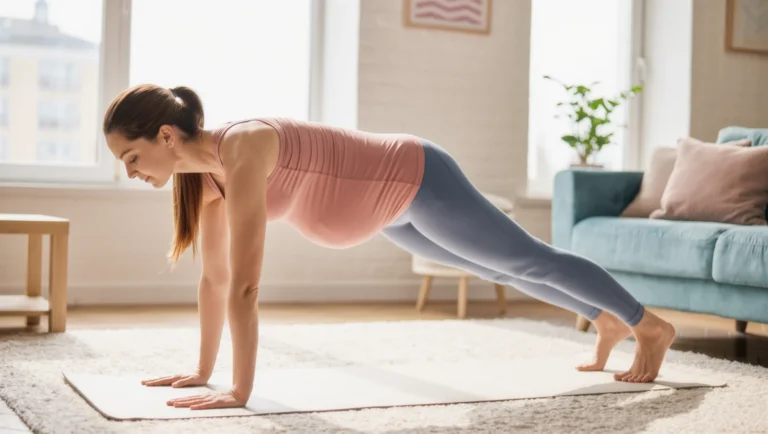
The NHS describes a gentle all-fours exercise that strengthens your tummy muscles and can ease back pain. Pregnancy yoga and aquanatal classes with a qualified instructor can help too. A Cochrane review found that exercise improved lower back pain, but the evidence is low quality – so listen to your body.
Read alsoMorning Sickness: What Really HelpsAnxiety During Pregnancy: Is It Normal and What Helps
The “cat” exercise step by step, as described by the NHS:
- Start on all fours: knees under hips, hands under shoulders, fingers facing forwards, tummy lifted, back straight.
- Pull in your tummy muscles and raise your back towards the ceiling, letting your head and bottom relax gently downwards. Don’t lock your elbows and only move as far as is comfortable.
- Hold for a few seconds, then slowly return to the starting position without hollowing your back.
- Repeat slowly and rhythmically 10 times.
You’ll find more ideas for safe movement in our guide Exercise and Sport During Pregnancy. If you have any health conditions, check with your doctor first.
Is it back pain or pelvic pain?
Lower back pain sits low in your back and often gets worse in the evening. Pelvic girdle pain (PGP), according to the NHS, is felt at the front over the pubic bone, across one or both sides of the lower back or spreading to the thighs, and gets worse with walking, stairs and turning over in bed.
| Lower back pain | Pelvic girdle pain (PGP) | |
|---|---|---|
| Where | Lower part of the back | Over the pubic bone, lower back, between the legs, thighs |
| Worse when | Evening, after long standing or sitting | Walking, stairs, standing on one leg, turning in bed |
| How common | More than 2 in 3 pregnant women (Cochrane) | Up to 1 in 5 pregnant women (NHS) |
| What the NHS says | Habits, rest, gentle exercise | Call your midwife – you may be referred to a physiotherapist |
According to the NHS, pelvic pain isn’t harmful to your baby and most women with it can have a vaginal birth. Getting advice early does help keep the pain down, though.
How should I sleep when my back hurts?
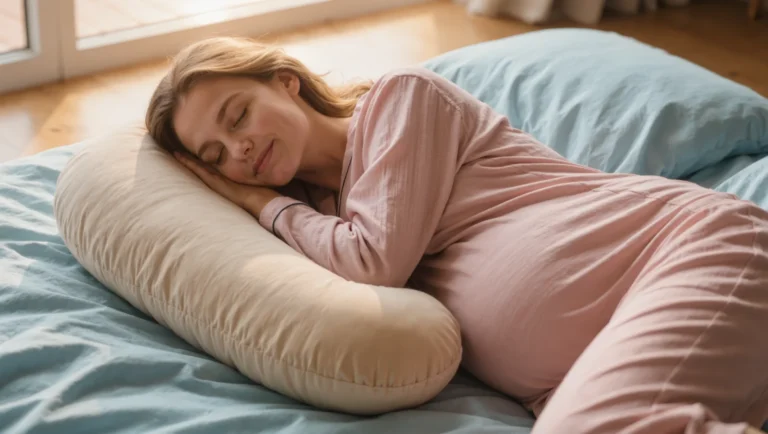
ACOG says that later in pregnancy it’s best to sleep on your side with one or both knees bent. A pillow between your knees and another under your bump can help, and some women love a full-length body pillow. The NHS adds: get enough rest, especially later in pregnancy.
More on positions and sleepless nights in Sleep During Pregnancy: Positions, Pillows and Insomnia.
Get out of bed “log-roll” style: bend your knees, roll onto your side with them, then push yourself up to sitting with your arms. Getting out of the car? Keep your knees together, as the NHS suggests. It looks like a ballet move, but your back adores it. 😊
Flat shoes or low heels in pregnancy?
Here the sources differ slightly. The NHS recommends flat shoes to spread your weight evenly. ACOG prefers a low (but not completely flat) heel with good arch support, such as trainers. Both agree on one thing: high heels aren’t a great idea.
For dads
You’re now the official carrier of shopping bags, laundry baskets and anything lower than knee height. Pop a cushion behind her lower back before she sits down and run a warm bath in the evening. Small things, huge relief.
When should I call my doctor or midwife?
Talk to your doctor before you change anything. Call your doctor or midwife if the pain is severe or lasts more than two weeks (ACOG). If you’re thinking about a painkiller, don’t decide alone – your doctor decides whether it’s suitable and the dose, and your pharmacist can explain the leaflet.
According to the NHS and ACOG, contact your doctor or midwife urgently if you have back pain and:
- you’re in your second or third trimester – it could be a sign of early labour;
- you also have a fever, vaginal bleeding, or pain or burning when you pee;
- you have pain in one or both sides, under your ribs.
Get emergency help straight away (112 in the EU, 999 in the UK) if, along with back pain, you lose feeling in one or both legs, your bottom or your genitals. For other signs it’s time to go to hospital, see Signs of Labour: When to Head to the Hospital. Your doctor and midwife know your pregnancy – trust them.
In short
A sore back in pregnancy is like a backpack that gets a little heavier every day: you can’t take it off, but you can adjust it so it sits more comfortably. Small habits, gentle movement and help at home work wonders. You’re carrying a whole world – and doing beautifully. 💛
More guides for this stage: Pregnancy.
Sources: NHS – Back pain in pregnancy; NHS – Pelvic pain in pregnancy; ACOG – Back Pain During Pregnancy (FAQ); Cochrane Review (2015) – Interventions for preventing and treating low-back and pelvic pain during pregnancy.