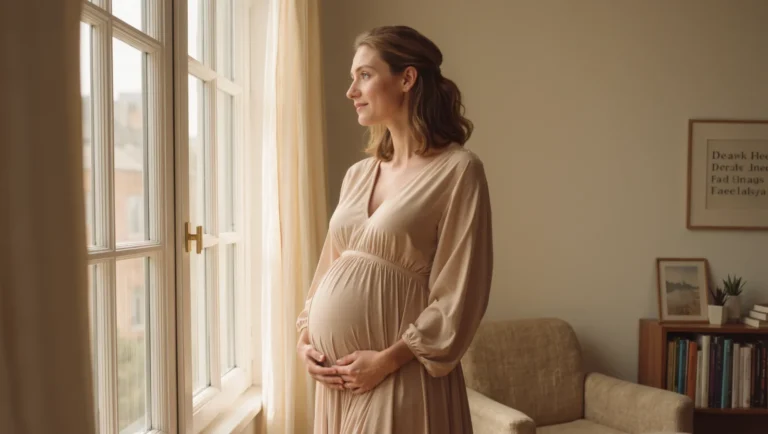


A pregnancy bump usually starts to show in the second trimester – most often somewhere between weeks 12 and 20. The NHS notes that a small bump may become visible around week 13, but for many women it appears later. There is no such thing as a “late” bump – just different bodies. 🌿
You’re standing sideways in front of the mirror, pushing your belly out a little, then pulling it back in. “Is that the baby, or last night’s pizza?” If you’re 10 weeks along and your jeans already feel tight, while your friend at 18 weeks still wears her usual ones – don’t panic. Both are completely normal.
If you feel confused or impatient, that’s totally understandable. The bump is the first visible “hello” from your baby, and of course you’re waiting for it. Relax, it’s all fine: it will arrive at its own pace.
When do you start showing in your first pregnancy?
In a first pregnancy, the bump usually becomes noticeable during the second trimester. According to the NHS, a small bump may appear around week 13 as the womb grows upwards and outwards. WebMD names weeks 16–20 as the typical window, and for some women the bump only shows at the end of the second or in the third trimester.
The reason is simple: in the early weeks the uterus (the organ where your baby grows) is still small and sits low in the pelvis. The NHS notes that your bump won’t usually show before the second trimester – which is also why sleeping on your tummy is perfectly fine early on.
Why do you show earlier in a second pregnancy?
In a second or later pregnancy, the bump often shows sooner. According to WebMD, this is because the abdominal muscles have already been stretched once and relax more easily. Experience helps too: you know what to look for, so you notice the change earlier. Some women see a bump as early as the first trimester.
Other things matter as well: your height, body shape, core strength, weight before pregnancy and whether you’re expecting twins. With a higher body weight, the bump may not look rounded until the third trimester – and that’s another version of normal.
Take a side-on photo once a week, in the same spot and the same clothes. After a month you’ll see a change the mirror can’t catch day to day. And years from now, it’ll be your favourite family album. 📸
Bloating or baby bump: how can you tell in the early weeks?
In the first weeks, the “bump” is very often bloating rather than a growing womb. The NHS lists bloating among the common symptoms of early pregnancy. Bloating comes and goes during the day, while a real bump grows gradually and stays.
- Bloating: bigger in the evening, smaller in the morning, often with a heavy feeling after meals.
- Bump: firm and low, just above the pubic bone, and still there after a night’s sleep.
- Your clothes: if the waistband only pinches in the evening, it’s probably bloating.
How does the womb grow week by week?
The womb climbs gradually from the pelvis towards the chest. According to Cleveland Clinic, at around 12 weeks its top is almost level with the pubic bone, at around 20 weeks it reaches the belly button, and at around 36 weeks it reaches the breastbone. After that it may drop slightly as the baby settles into the pelvis before birth.
Read alsoTravelling while pregnant: the best time to go and what to knowBack pain in pregnancy: what helps and when to call
| Week (approx.) | Where the top of the womb is | What you may notice |
|---|---|---|
| around 12 | almost level with the pubic bone | usually nothing on the outside yet |
| around 13–16 | above the pelvis | a first small bump, fewer trips to the loo |
| around 20 | at the belly button | the bump shows for most women |
| around 36 | up to the breastbone | the highest point |
| after 36 | may drop slightly | a “lower” bump |
You’ll find more on the changes stage by stage in Pregnancy by Trimester: What’s Happening to You and Your Baby.
How does the midwife know if your bump is “on track”?
The size of a bump by eye says very little – it’s measured with a tape measure. According to Cleveland Clinic, after about week 20 the distance from the pubic bone to the top of the womb in centimetres is close to the week of pregnancy: at 24 weeks, about 24 cm. If something doesn’t match, an ultrasound scan is usually arranged.
- You lie on your back on the couch for a minute.
- The midwife or doctor feels for the pubic bone and the top of the womb.
- The distance is measured in centimetres with a tape.
- The result is plotted on a chart so growth can be followed over time.
At NHS Lothian (Scotland), midwives measure the bump this way at every appointment from 24 weeks. If the measurement suggests the baby may not be growing as expected, a scan is offered. The focus is on your baby – not on how you look in photos.
“You’re hardly showing!” and “Wow, is it twins?” come as a package deal. A smile and “My midwife says we’re right where we should be” closes the topic beautifully. 😊
For dads
You’re waiting for the bump too – and that’s lovely. Don’t comment on its size (neither “small” nor “big”); ask how she’s feeling instead. Take charge of the weekly side-on photo and save it in a shared album. When clothes start to pinch, offer to find comfy ones together – a small gesture, a big difference.
When should you ask your doctor or midwife?
Most differences in bump size are simply differences between bodies. Ask your doctor or midwife if:
- in the third trimester your bump is still barely noticeable;
- your bump grows suddenly over a short time or suddenly looks smaller;
- you have pain, bleeding or anything else that worries you – then seek medical help straight away.
They track your baby’s growth with measurements and scans, and they know your pregnancy. Your question is never a silly one.
If your bump is already making it hard to get comfy at night, see Sleep During Pregnancy: Positions, Pillows and Insomnia, and everything for the stage you’re at is in Pregnancy.
In short
A bump usually appears between weeks 12 and 20 – earlier in a second pregnancy, later in a first – and every version is normal. Its size isn’t a grade for how well your pregnancy is going; that’s what the tape measure, the scans and your midwife are for. Your baby is growing at their own pace, and you’re already carrying them with so much love. 💛
Sources: NHS Best Start in Life – Week 13; NHS Start for Life – Week 14; Cleveland Clinic – Fundal Height; NHS Lothian – Knowing when a baby is not growing as well as expected; WebMD – When Do Pregnant Women Start Showing?.