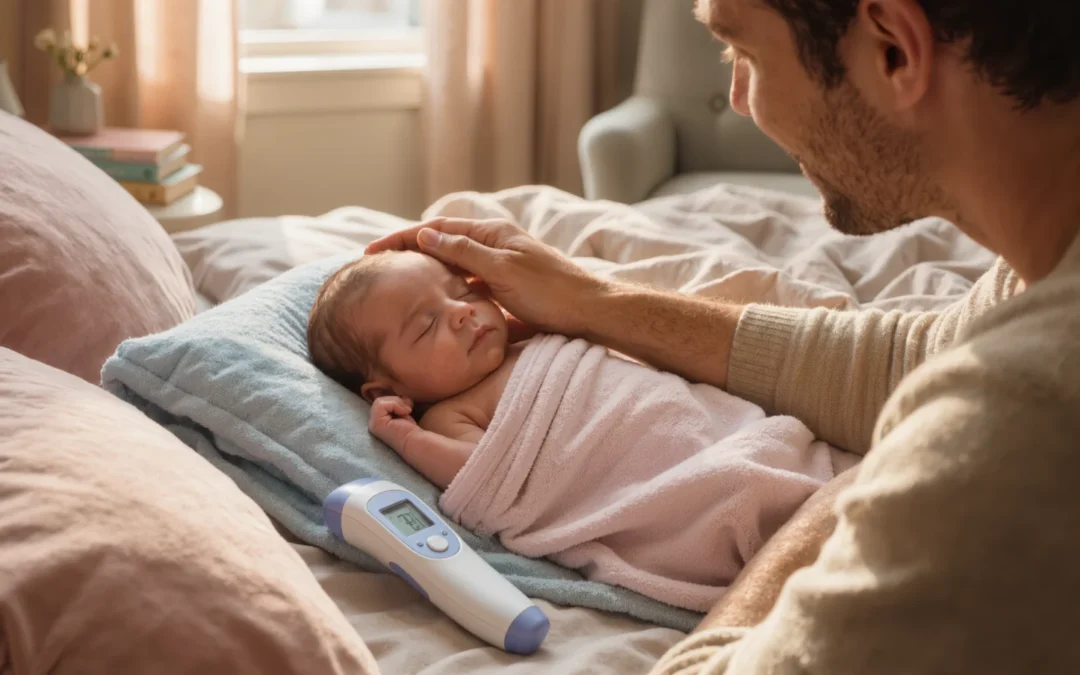
The thermometer reads 38.2 and your heart skips a beat. Completely understandable – when your baby is hot and grizzly, everything feels scarier, especially at night. The good news: in most cases a fever is a sign that the little body is doing its job and fighting off an infection.
What matters is knowing when it’s enough to keep an eye on things and when it’s time for a doctor. Here’s a clear map, no panic.
The short answer: Under 3 months, 38°C or more: contact a doctor straight away. At 3–6 months, 39°C or more: get medical advice. Over 6 months, how your baby looks and behaves matters more than the number. Call 112 for a rash that doesn’t fade under a glass, trouble breathing, a seizure or a baby who is hard to wake.
What counts as a “high” temperature in a baby?
According to the UK’s NHS, a high temperature in a child is 38°C or more. The younger your baby, the sooner it’s a good idea to call a doctor:
- Under 3 months – a temperature of 38°C or more: contact a doctor straight away, don’t wait.
- 3 to 6 months – a temperature of 39°C or more: get medical advice.
- Over 6 months – how your baby looks and behaves matters more than the number itself.
That’s exactly how the “traffic light” system from the UK’s NICE works – doctors use it to assess a child by skin colour, activity, breathing and hydration, not just by the degrees.
For babies up to 4 weeks old, the most accurate way is under the armpit with a digital thermometer. Don’t rely on the “hand on the forehead” check – your hand is a lovely but imprecise instrument. 😉
How to measure it properly
- Use a digital thermometer. Mercury ones are long gone – they break and they’re dangerous.
- Measure under the armpit, holding your baby’s arm snugly against their body until the thermometer beeps.
- Don’t measure straight after a bath or if your baby is heavily bundled up – the reading will be higher.
- Write down the time and the reading. Your paediatrician will thank you.
What can you do at home?
- Fluids – offer the breast or formula often. Dehydration (losing too much fluid) is a bigger risk than the fever itself.
- Light clothing – don’t wrap your baby in blankets to “sweat the fever out”. That only overheats them.
- Don’t wake them just to take their temperature if they’re sleeping peacefully.
- Medicines – give an antipyretic (a fever-reducing medicine) only as advised by your doctor and according to the leaflet. The goal is for your baby to feel better, not to “bring the number down” at any cost.
- Don’t use cold sponging, vinegar or alcohol rubs – they’re not recommended and only upset your baby.
When to call your paediatrician
- Your baby is under 3 months old with 38°C or more.
- Your baby is 3 to 6 months old with 39°C or more.
- The fever lasts 5 days or longer.
- Your baby refuses to feed, has noticeably fewer wet nappies or is floppier than usual.
- You have a feeling that something isn’t right. Your instinct is an important signal too.
When to call 112
Call 112 straight away if your baby:
- has a rash that doesn’t fade when you press a clear glass against it;
- is struggling to breathe, breathing fast or sucking in under the ribs;
- is unusually sleepy, hard to wake or not responding as usual;
- has a seizure (a fit with twitching of the body);
- has a stiff neck or pale, grey or bluish skin, lips or tongue.
Make a note on your phone: your paediatrician’s number, your baby’s weight and when they last had any medicine. At 3 a.m., memory isn’t your best friend.
For the dads
Night duty with the thermometer is the perfect mission for you. Measure, write it down, bring Mum some water and the baby their bottle. You’re a team.
In short
A fever isn’t the enemy, it’s a signal. Watch your baby, not just the number, keep the fluids coming and don’t hesitate to see a doctor when something worries you – no paediatrician will ever blame you for asking. You know your baby better than any thermometer, and that’s your strongest tool. 💛
Sources: NHS – High temperature (fever) in children; NICE – Fever in under 5s: assessment and initial management (NG143); American Academy of Pediatrics (HealthyChildren.org) – Fever: When to Call the Pediatrician.
More from this section


Your baby, week by week
Once a week: what's coming up, one useful tip and nothing extra.