

This guide may contain affiliate links. If you buy through them, we may earn a small commission at no extra cost to you. Learn more
A newborn’s first bath often feels like a high-difficulty mission: small, slippery, wriggly – and you only have two hands. If you feel unsure, that’s the most normal thing in the world. Every parent has been right there.
The nice thing is that bathing is learned quickly. By the third or fourth time, your hands will know what to do, and bath time may well become your favourite time together. Here’s how to make it calm and safe.
How often should you bath a newborn?
Less often than you’d think. For a newborn, 2–3 baths a week are usually enough. Their skin is delicate and frequent bathing can dry it out. In between, it’s perfectly fine to clean their face, neck, hands and nappy area.
The cord stump hasn’t fallen off yet?
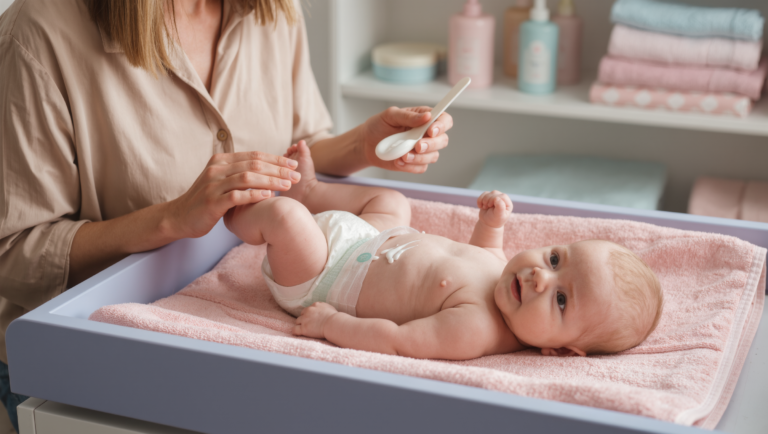
Until the umbilical cord stump (the little leftover piece of the cord) falls off and the area heals, it’s recommended to wash your baby with a damp cloth or sponge rather than putting them in the bath. That keeps the belly button dry so it heals more easily.
Get everything ready before you undress your baby: towel, clean nappy, clothes, a cloth. When everything is within arm’s reach, you won’t need to turn away – and that’s the most important rule in the bathroom.
Step by step
- Warm up the room. Babies get cold quickly, so the bathroom should be pleasantly warm and draught-free.
- Run a little water – a few centimetres is enough.
- Check the temperature. The water should be around body temperature – about 37°C is often quoted. If you don’t have a bath thermometer, dip your elbow in: the water should feel pleasantly warm, neither cold nor hot.
- Start with the face. Using clean cotton wool dipped in water, wipe each eye from the inner corner outwards, with a fresh piece for each eye.
- Lower your baby in slowly, supporting their head and shoulders with one hand and their bottom with the other.
- Wash them gently – neck, skin folds, hands, and finally the nappy area. For a newborn, plain water or a very mild, fragrance-free product is often enough.
- Dry straight away with a soft towel, especially in the folds, and get your baby dressed.
The whole bath can take just a few minutes. It’s not a cleanliness contest – shorter is better.
When is the best time?
Not right after a feed, and not when your baby is very hungry or tired. Pick a moment when they’re awake and calm and you’re not in a rush. Many families make the evening bath part of their bedtime routine. 🛁
The rule with no exceptions
Never leave your baby alone in the bath – not even for a second. A baby can drown in a very small amount of water. If the phone or the doorbell rings, wrap your baby in the towel and take them with you. Bath seats don’t replace you being there – a baby in one is never left unsupervised either.
Your baby cries in the water? Try wrapping them in a thin, wet muslin while you bath them – the feeling of being wrapped soothes lots of babies. Or simply do bath time together with the other parent: four hands are calmer than two.
For the dads
Bath time is the perfect “dad job”. Your baby gets to know your voice and your hands, and Mum gets fifteen minutes just for herself. Lots of dads say it was in the bath that they first felt truly close to their baby.
When to ask a doctor
If you notice redness, swelling, an unpleasant smell or discharge around the belly button, or a rash or very dry, cracked skin after bathing, mention it to your paediatrician or health visitor.
In short
A warm room, a little water, everything ready – and you, always right next to your baby. There’s no “perfect” technique, only yours, which you’ll find within a few evenings. The first bath may be a bit clumsy, but soon you’ll be doing it like a pro – with a smile and wet sleeves. 😊
Sources: NHS Start for Life – Bathing your baby; London North West University Healthcare NHS Trust – Washing and bathing your baby; Cincinnati Children’s – What Should You Know About Your Baby’s Umbilical Cord?.
More from this section


Your baby, week by week
Once a week: what's coming up, one useful tip and nothing extra.
