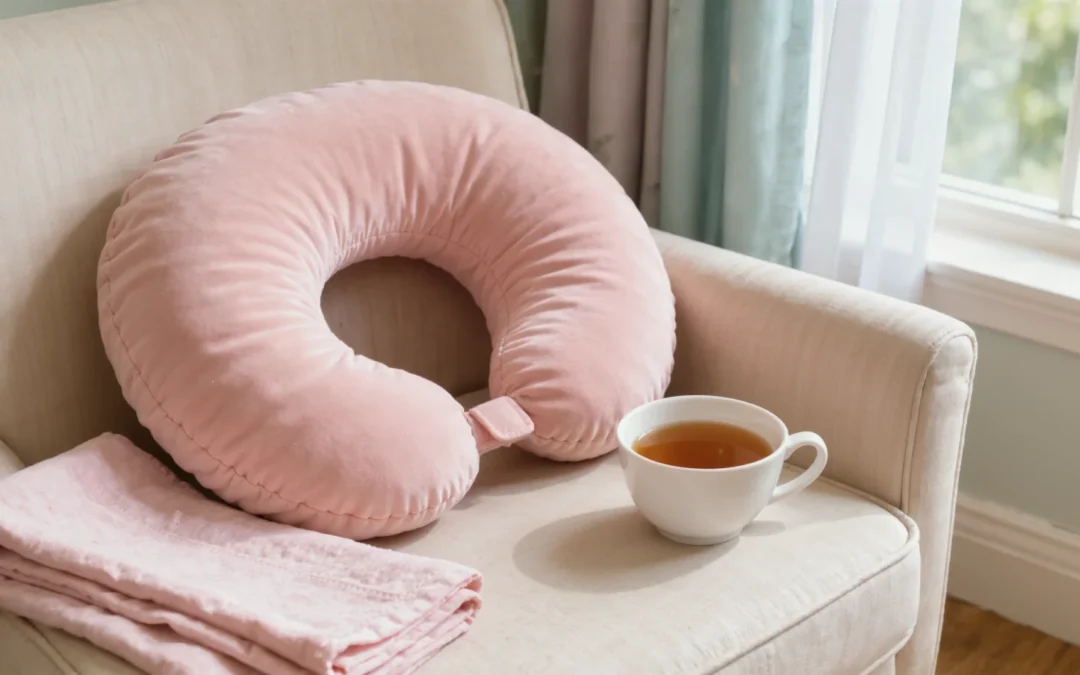
It’s 4 a.m., your baby is rooting for the breast, and you’re holding them with one arm, propping your elbow on the armrest with the other, while your shoulders slowly climb towards your ears. 😅 And somewhere in there you think: “I really should have bought that nursing pillow.”
If the wall of options – C-shaped, U-shaped, huge, tiny, “2-in-1” – leaves you confused, that’s completely understandable. Don’t worry, it’s all fine. A nursing pillow isn’t a must-have, but it can make feeds easier on your back and arms. What matters is picking one that suits you and knowing one simple safety rule. You’ve got this.
The short answer: Choose a nursing pillow to suit your body and where you feed: a C-shape is compact, a U-shape gives more support and a firm filling keeps baby steady. It is for feeding an awake, supervised baby only – never for sleep, never leave baby alone in it, and keep it out of the cot.
What is a nursing pillow actually for?
It lifts your baby to the height of your breast (or the bottle), so you don’t hunch over or carry their whole weight in your arms. According to the NHS (the UK’s health service), it’s worth getting comfortable before each feed – with pillows or cushions if you need them – so your shoulders and arms are relaxed.
The NHS also gives a few pointers for the feed itself, pillow or no pillow:
- Your baby’s head and body are in a straight line: it’s hard to swallow with a twisted neck.
- Your baby is held close, facing your breast: you support their neck, shoulders and back so they can tilt their head back slightly.
- Their nose is level with your nipple: this encourages a wide-open mouth and a better latch.
- You bring baby to the breast, not the breast to baby: leaning forward often leads to a poorer latch.
A pillow simply makes all of this easier. If you’re just starting out, have a look at our guide to the first days of breastfeeding.
What should you ask yourself before buying?
- Where will you feed most? On the sofa, in an armchair, in bed? Do you sit high or low?
- What’s your body shape? The pillow should hug your waist without squeezing or leaving a big gap.
- How much space do you have? A large U-shape is comfy but takes up half the sofa.
- How often will you wash it? Spoiler: a lot. Milk, spit-up, the nappy that didn’t quite hold…
What types are there, and how do they differ?
- C-shaped (crescent): the most common shape. Compact, easy to move around, works for most positions. Downside: may not wrap well around a larger body.
- U-shaped: surrounds you more closely and gives side support too. Downside: bulkier and harder to carry.
- Firm feeding pillow: denser filling keeps baby at a steady height without sinking. Downside: some find it less cosy to lean on.
- Soft pregnancy pillow (long, banana or U-style): designed for your comfort while you rest and sleep. Downside: often too soft and too big to hold a baby steadily during feeds.
- Removable, washable cover: pretty much essential. A spare one is a bonus.
Approximate budgets (prices vary by shop and brand): around €20–35 for a basic C-shape; around €35–60 for denser filling and a better cover; around €60–90 and up for large U-shapes, twin models or organic fabrics. Pricier doesn’t automatically mean better for you.
If you can, test the pillow sitting the way you’ll actually feed – with a handbag or a bag of flour standing in for the baby. If your elbows still hang in mid-air or you have to lean forward, it’s not your model. The flour won’t complain. 😊
Why is safety the most important filter?
A nursing pillow is for feeding – with an awake baby and you right there. It’s not for sleep, and it’s not a spot for baby to “just lie there for a bit”.
In the US, the CPSC (Consumer Product Safety Commission) adopted a mandatory standard for nursing pillows, published in 2024 and in force since 23 April 2025. The Commission notes that these pillows are sometimes used for sleep or lounging, and that this has led to infant deaths and serious injuries from suffocation, entrapment or falls. The standard requires:
- Firmness: the surface baby lies on and the inner wall must not give too much – tested again after washing according to the instructions.
- No infant restraints: a strap could entangle a baby and suggest it’s fine to leave them unattended.
- A clear warning that babies have died when nursing pillows were used for sleep or lounging, and that the pillow is for feeding only.
- Advice to move baby to a sleep product if they fall asleep or if you feel drowsy.
Some nursing pillows have also been recalled in the US over suffocation risk. The standard is American, but its logic applies wherever you shop.
The AAP (American Academy of Pediatrics) advises against using products for sleep that aren’t made for infant sleep – and gives nursing pillows as an example. A sleep space should be firm, flat and clear: no pillows. The NHS likewise advises keeping the cot free of pillows, pods, nests or anything that holds baby in place. More on this in our safe sleep guide.
In practice:
- Only with an awake, supervised baby.
- Never leave your baby alone on or in the pillow, not even “for a minute”.
- Keep it out of the cot. It’s small enough to fit inside – which is exactly why it doesn’t belong there.
- If baby dozes off after a feed, move them onto their back in the cot.
Night feeds in an armchair are cosy – sometimes a bit too cosy. The NHS advises not to fall asleep with your baby on a sofa or in an armchair. If your eyelids get heavy, put baby down in the cot first, then let yourself drift off. Having the cot right next to the chair helps a lot. 🌿
For dads
You’re in charge of logistics. Set up the “feeding station”: the pillow, water for mum, a burp cloth and a clear cot nearby. And when baby falls asleep on the pillow, you’re the one who gently carries them to the cot. Small gesture, big difference. 👏
In short
A good nursing pillow is like a comfy chair for your back – it helps, but it’s not a babysitter. Choose the shape and firmness that fit your body and habits, look for a removable cover, and use it only while your baby is awake and you’re right there. You know your feeds better than anyone – and you’re doing better than you think. 💛
Sources: CPSC – Safety Standard for Nursing Pillows, final rule (Federal Register, 25 Oct 2024; effective 23 Apr 2025); AAP / HealthyChildren.org – How to Keep Your Sleeping Baby Safe: AAP Policy Explained; NHS – Breastfeeding: positioning and attachment; NHS – Sudden infant death syndrome (SIDS): how to reduce the risk.
More from this section
Your baby, week by week
Once a week: what's coming up, one useful tip and nothing extra.