
This guide may contain affiliate links. If you buy through them, we may earn a small commission at no extra cost to you. Learn more
Two in the morning. Their forehead feels warm, and you’re rummaging through the medicine drawer. The last thing you need at a moment like that is an unfamiliar gadget with five buttons. 🌡️
The good news is that a good thermometer isn’t complicated. One calm choice now will save you stress later.
What types are there?
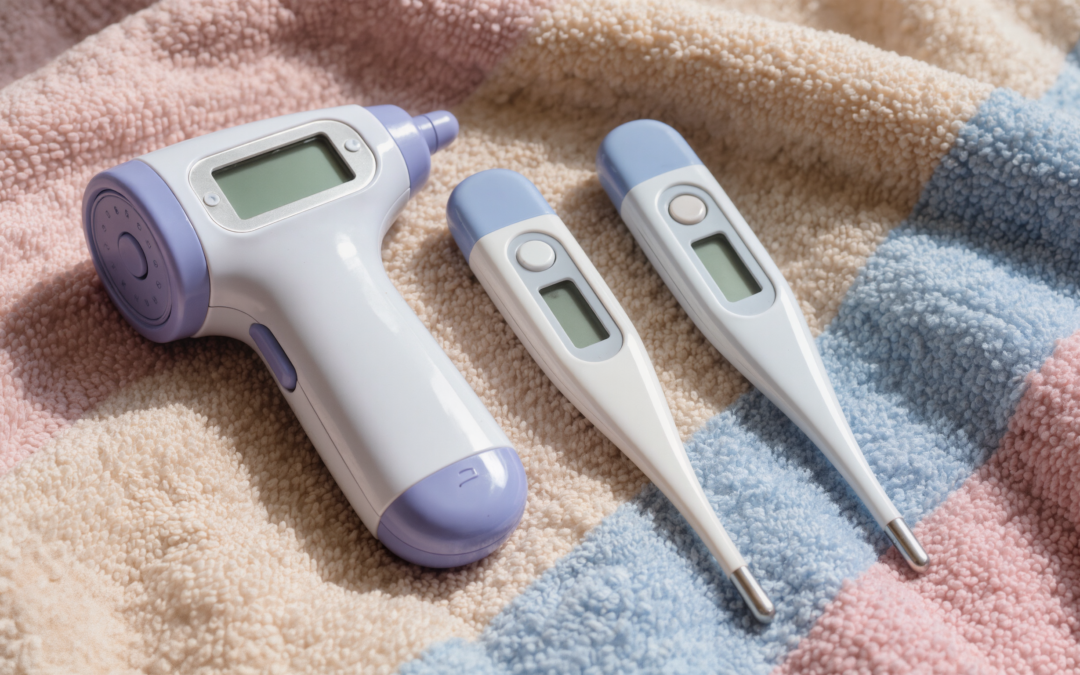
- Digital (stick-type). The most common. Used under the armpit and, with some models, rectally (in the bottom). Cheap, simple and reliable.
- Ear (infrared). Fast – just seconds. Needs the right technique and a clean probe, often with replaceable covers.
- Forehead (no-touch or swipe). The most convenient for a sleeping baby and hygienic, but more sensitive to conditions.
How accurate are they?
According to the MSD (Merck) Manual, a rectal reading is closest to true core body temperature. Under the armpit is less accurate. Ear thermometers are unreliable in babies under 3 months, and forehead ones are less accurate than rectal, especially at that age.
The NHS, the UK’s health service, on the other hand advises parents to use a digital thermometer under the armpit. Different countries have different practices – that’s normal. If you’re not sure which method to choose, ask your paediatrician what they prefer.
When you tell the doctor the temperature, also say how you measured it – armpit, ear or forehead. The same number means different things with different methods.
How to take a temperature under the armpit
The NHS describes it in a few simple steps:
- put the tip of the thermometer high up in the armpit;
- gently hold your baby’s arm against their body;
- keep it there until the thermometer is done – it usually beeps.
With a wriggly baby, it helps to hold them on your lap and talk or sing to them. Yes, off-key counts – babies are the most forgiving audience there is.
How to choose
Ask yourself these questions:
- How old is your baby? If they’re under 3 months → a digital thermometer is the safest choice.
- What matters more to you – accuracy or speed? Lots of families keep two: a quick forehead or ear one for a “rough check”, and a digital one to confirm.
- Is the display easy to read in the dark? A backlight is a small thing that works wonders at night.
- Does it beep? Many digital thermometers beep when they’re ready.
- Is it easy to clean? For ear thermometers, check whether there are replaceable covers and where to buy them.
Consumer tests by the Australian organisation CHOICE show that good digital stick thermometers can achieve their stated accuracy of up to 0.1°C. Ear and forehead ones usually claim up to 0.2°C. As you can see, the simplest gadget is often a very serious player.
When to see a doctor
The NHS advises: if a baby under 3 months has a temperature of 38°C or higher, contact a doctor straight away. With older babies, also watch their general state – how they’re feeding, breathing and responding. And always trust your instincts: if something worries you, call.
Don’t take a temperature straight after a bath, when your baby is all bundled up, or when the room is very warm. Wait a little – that way the number will be more honest.
For the dads
Learn to take a temperature now, while your baby is well and calm. That way you’ll also know what’s normal for them – and the night-time check won’t be your first.
In short
A digital thermometer is a great basic for any first-aid kit, and quick ear and forehead models are a handy bonus for older babies. What matters is knowing your gadget and trusting it. Your next night-time check will be a lot calmer. 💙
Sources: NHS – High temperature (fever) in children; NHS – How do I take a temperature?; MSD Manual (Merck) – How to Take a Child’s Temperature; CHOICE – Baby thermometers buying guide.
More from this section


Your baby, week by week
Once a week: what's coming up, one useful tip and nothing extra.
